

A sourcing team can leave FABTECH with two sensible conclusions: investigate Vietnam for a family of fabricated brackets, and keep a complex assembly with its established Chinese supplier. Those decisions are compatible. They reflect different products, dependencies and costs of change.
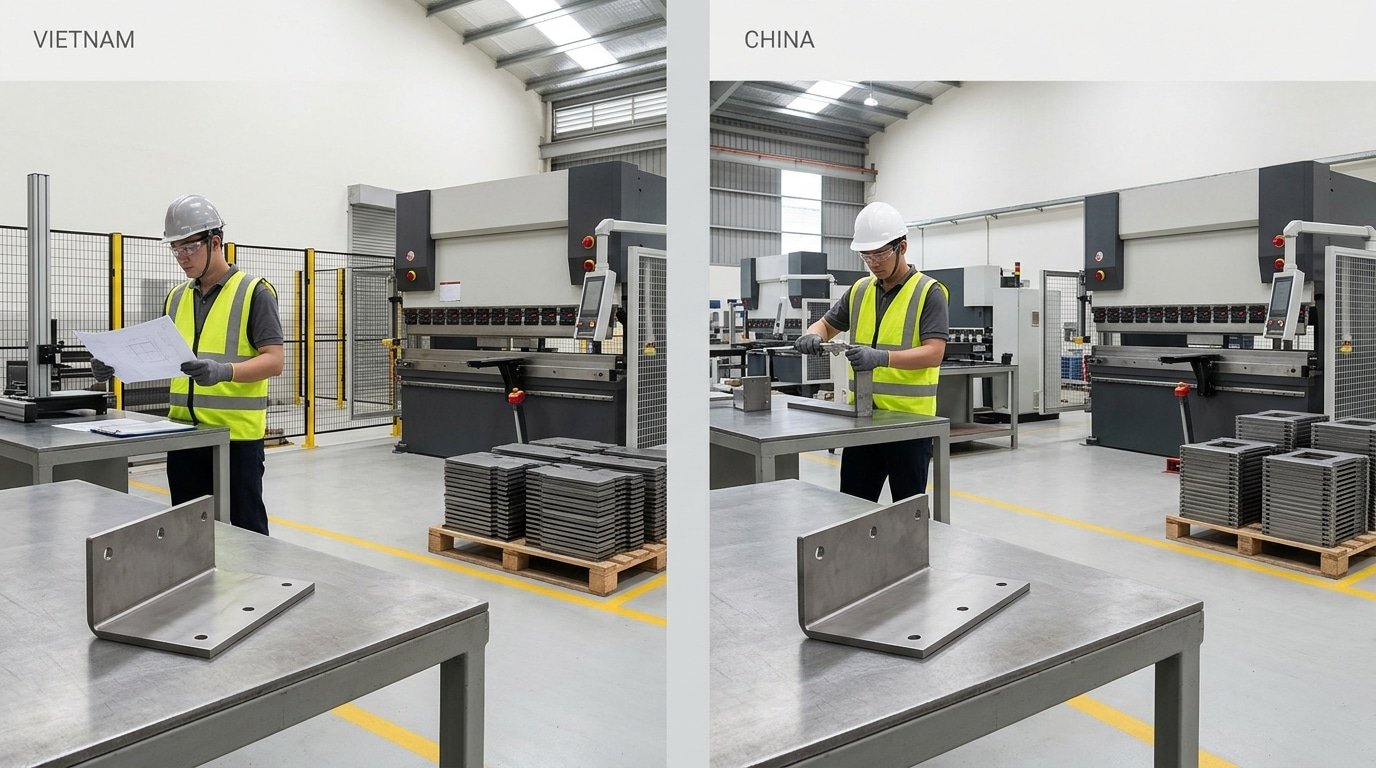
Consider an illustrative comparison. The bracket has a stable drawing, a specified steel grade and repeatable cutting, forming and finishing operations. The assembly combines custom castings, specialist coatings and several purchased components, with engineering changes still arriving. Moving either purchase order requires work, but the second involves rebuilding a much larger production network.
For 2027, the useful Vietnam versus China manufacturing question is therefore specific: which sourcing arrangement will meet this product’s requirements, at an acceptable total cost, with risks the business can manage? This article sets out how to make that comparison. For the broader sourcing process, start with our [Vietnam manufacturing guide for U.S. buyers].
Define a fair comparison
Keep specifications and commercial terms constant
Before judging two suppliers, make sure they are quoting the same job. Six conditions should be explicit: drawing revision, material specification, annual and batch quantities, inspection and acceptance requirements, delivery terms with a named place, and the quotation’s currency and validity period.
A supplier proposing a substitute alloy, a larger batch or a different coating may have a useful alternative. Record it separately. Otherwise, an apparent country advantage may simply be a change in the specification or order pattern.
Delivery terms also matter. ICC’s Incoterms® 2020 guidance explains how the rules allocate costs, risks and responsibilities. A price with freight included cannot be compared directly with a factory collection price. Identify the named place and reconcile the remaining responsibilities before presenting the figures to management.
Compare evidence at supplier level
Country research helps narrow a search. The sourcing decision ultimately needs evidence from the factories and subcontractors that would make the part.
Give the incumbent the same scrutiny as the candidate. Recent delivery performance, unresolved quality issues, tooling condition and exposure to bottlenecks belong in the comparison. Familiarity can hide an existing weakness; enthusiasm for a new source can hide an untested assumption.
Agree on the objective before collecting quotes. Lower recurring cost, additional capacity and reduced disruption exposure require different evidence. If management wants all three, establish which is essential and which can be traded off. A candidate that misses a mandatory product requirement should not win because its weighted score is attractive.
Compare supplier depth and technical fit
Tooling and upstream material availability
JETRO’s corrected FY2025 survey reports local procurement of 38.1% in Vietnam (n=337), versus 71.0% in China (n=343) among Japanese-affiliated manufacturing respondents. Local purchases include foreign-affiliated suppliers operating locally. This is neither an all-manufacturer census nor a customs-content measure. Fieldwork was August 19–September 17, 2025; the English release followed in January 2026.
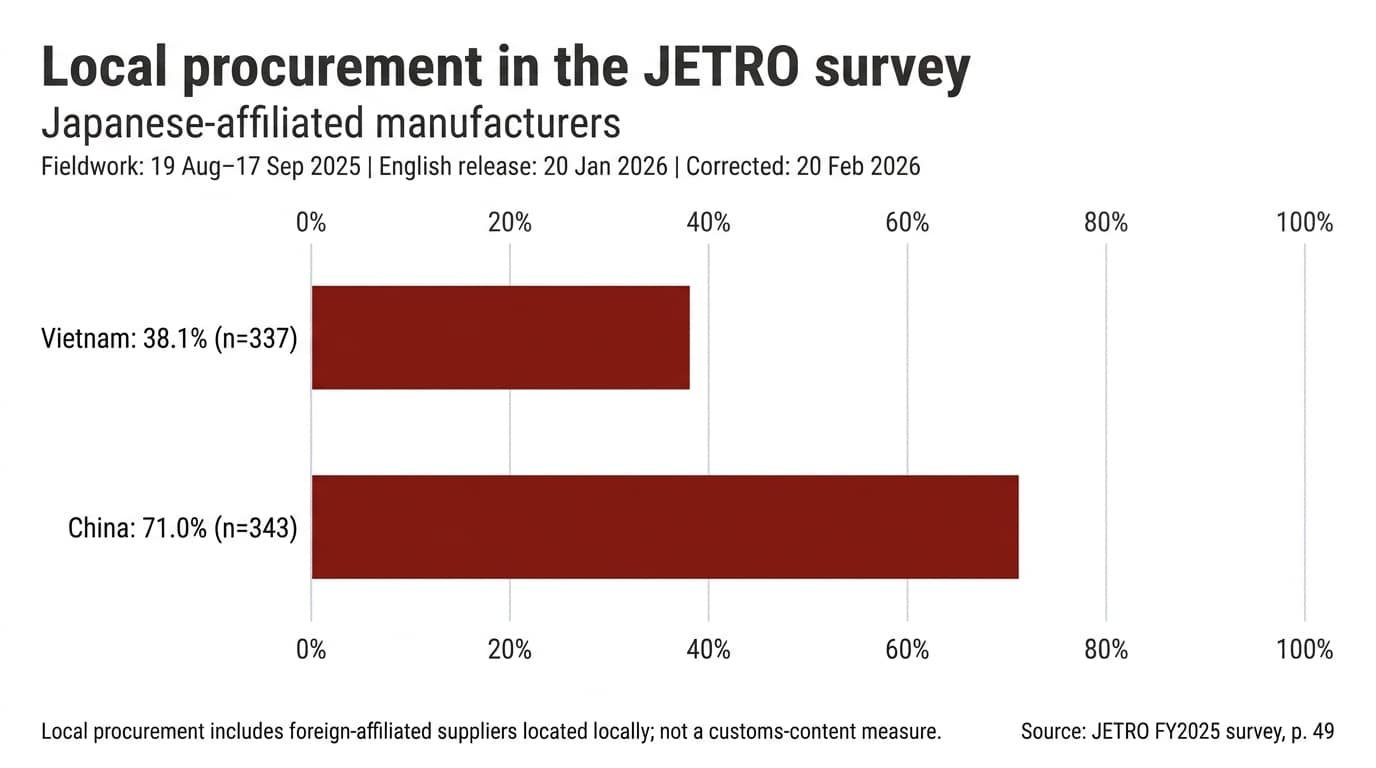
For a buyer, the practical implication is to investigate the supply network behind the quotation. Ask where the specified material is purchased, which operations leave the factory and who repairs or replaces critical tooling. The [Vietnam manufacturing landscape] provides a starting point for that investigation.
Process complexity and engineering changes
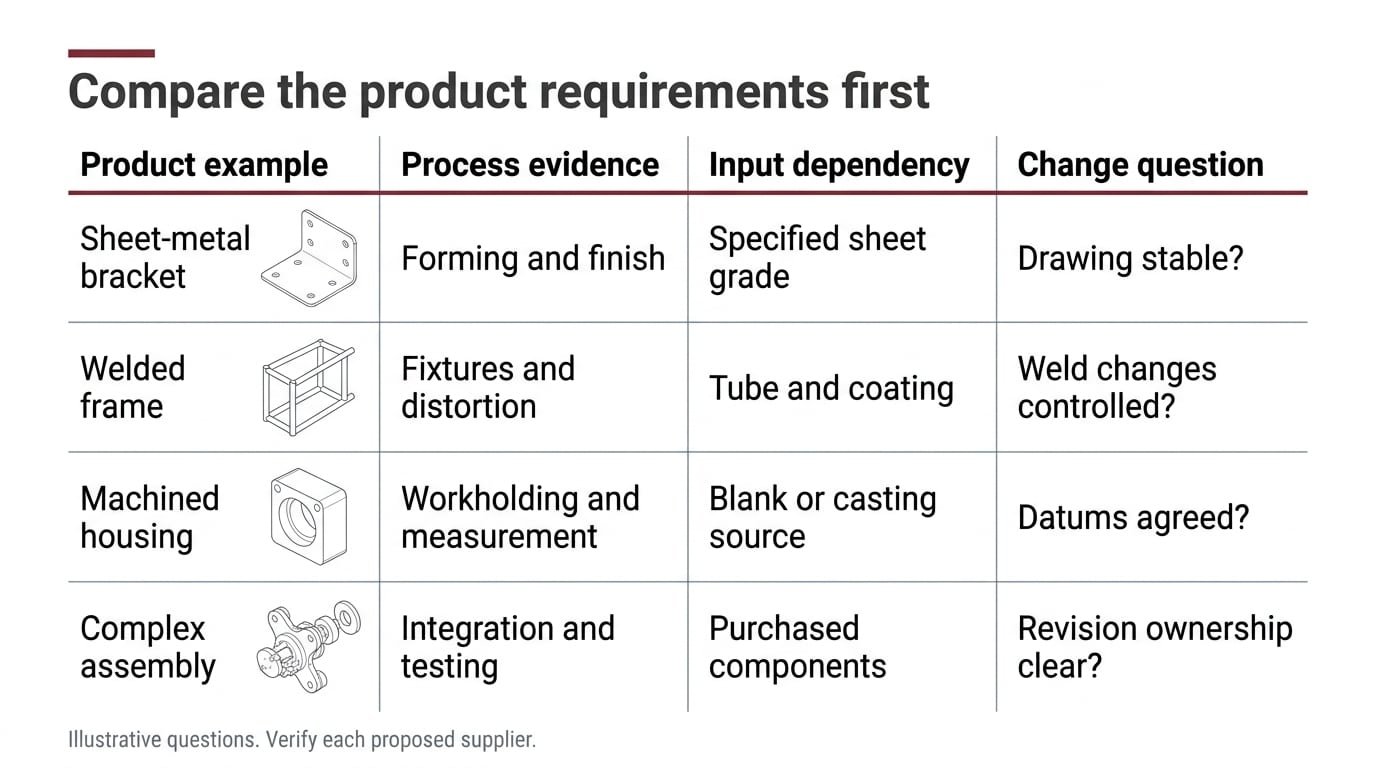
A machine list cannot establish whether a supplier can make your part repeatedly. For a welded frame, examine the proposed sequence, fixtures, distortion control and inspection access. For a machined housing, discuss datums, workholding and how critical features will be measured. For a coated enclosure, establish who controls preparation, finish consistency and transport protection.
The comparison becomes more demanding when designs change frequently. A supplier with qualified nearby subcontractors may resolve a tooling or finishing change quickly. Another may need an imported input and a new production slot. Either arrangement can work, but the response path needs to be understood before nomination.
Use the same questions for both countries. The detailed evidence belongs in [how to qualify a Vietnamese manufacturer]; here, the objective is to determine whether each proposed production route is credible.
Scale minimum orders and specialist services
Ask suppliers to explain the minimum order rather than accepting it as a fixed national characteristic. It may reflect a material mill quantity, casting run, coating batch, fixture setup or purchased-component commitment.
Check available capacity at the bottleneck operation. Installed machine hours have little value if the required operator, inspection equipment or outside processor is unavailable. A larger factory may also be a poor fit for a small, irregular program. Compare the capacity and attention allocated to your work, including what happens when the supplier’s other customers become busier.
Compare the economics beyond labor rates
Factory price and launch investment
Wages are one input into a manufactured part. Material utilization, cycle time, automation, scrap, setup frequency and process routing also affect the quoted price. A national labor-cost comparison cannot settle the economics of a specific enclosure or casting.
Separate the cost of operating the source from the cost of establishing it. New fixtures, tooling, samples, engineering reviews, testing and qualification can make the first year look different from steady production. Request those items separately and allocate them over a defensible quantity.
Treat the incumbent fairly. Money already spent on usable tooling is not a new cash outlay simply because the alternative requires new tools. Equally, an existing tool approaching replacement has a future cost that should not disappear from the baseline. Distinguish sunk expenditure, remaining obligations and costs that the decision will actually change.
Lower volume after a split can also change pricing at both suppliers. Requote realistic allocations instead of applying full-volume prices to two smaller programs.
For a new product without an incumbent, the comparison is different. Both candidates may need tooling and process development, so the decision is about competing launch proposals rather than the burden of replacing an established source. Ask each to identify the development work included, the assumptions still open and the point at which the production price becomes firm. Keep this new-product case separate from a transfer case in your management review; combining them can obscure why one program is attractive and another is not.
Freight duties inventory and quality cost
Compare the cost to the same receiving location. Include the transport arrangement, packaging, inspection, applicable import charges and foreseeable receiving costs. Beyond arrival, consider inventory carrying costs, rework and the administrative effort required to manage the source.
Keep duty assumptions dated and product-specific. The place from which a shipment departs is insufficient to establish all U.S. import obligations. Classification, production facts and the applicable measures need review; a broad country tariff headline is not a reliable cost input.
Our [total landed cost of manufacturing in Vietnam] explains how to organize that calculation. At the strategy stage, test whether the preferred option still makes sense if demand is lower, launch takes longer or replenishment requires more inventory than expected.
A resilience-led project may be worth pursuing without an immediate unit-price reduction. State the trade-off openly: what disruption exposure is reduced, what maintaining the alternative costs, and what evidence supports its ability to respond. That is a more useful investment case than attributing every benefit to savings.
Compare delivery and engineering responsiveness
Replenishment lead time versus first order lead time
An established supplier’s repeat-order lead time and a candidate’s first-production schedule measure different things. The latter may include drawing clarification, material approval, tooling, samples and a production trial before regular replenishment begins.
Ask each supplier to separate those activities. Define the starting event and finishing event for every lead-time claim. Does the clock begin with a purchase order, a deposit, approved drawings or available material? Does it end at factory release, port departure or receipt at your facility?
Then examine the route behind the estimate: imported material, consolidation frequency, outside processing and the point at which capacity is reserved. A shorter promised schedule with several unconfirmed dependencies may be less useful than a longer, well-supported one.
Design changes and recovery from disruption
Use a concrete engineering question to assess responsiveness. For example, ask what would happen if a hole position changed after cutting but before forming. Who reviews the revision, identifies affected work in progress, calculates the impact and authorizes the change?
The purpose is to see how information moves. A quick sales reply does not establish that production and quality teams are working from the same revision. Ask who owns technical decisions and how disagreements are escalated across time zones.
Discuss recovery with equal specificity. If a critical machine stops, is the alternative process already approved? If a shipment fails inspection, who contains the affected lots and supplies replacement evidence? A candidate should show a credible response method; the incumbent should demonstrate how that method has worked on your program. Record the differences rather than reducing them to a country-level “service” score.
Check whether diversification reduces shared dependencies
Separate factory ownership from production facts
A July 2026 Federal Reserve research note on Vietnam’s export growth finds that relocation by foreign-owned firms, including Chinese firms, helps explain changes in trade. It also notes that existing research suggests transshipment has a limited quantitative role. The analysis does not determine the customs origin or compliance of an individual supplier’s goods.
Ownership, manufacturing location and input sourcing answer different questions. A Chinese-owned factory in Vietnam should be assessed through its actual operations and records, just as any other factory should. For U.S. marking purposes, 19 CFR 134.1 links origin to manufacture, production or growth, with substantial transformation relevant to further processing. Other applicable regimes may require separate analysis. Shareholder nationality alone is not a sourcing conclusion.
Map shared materials tooling and subcontractors
Two final-production sites can still rely on one mill, foundry, component manufacturer or toolmaker. If that common input is interrupted, both sites may lose output.
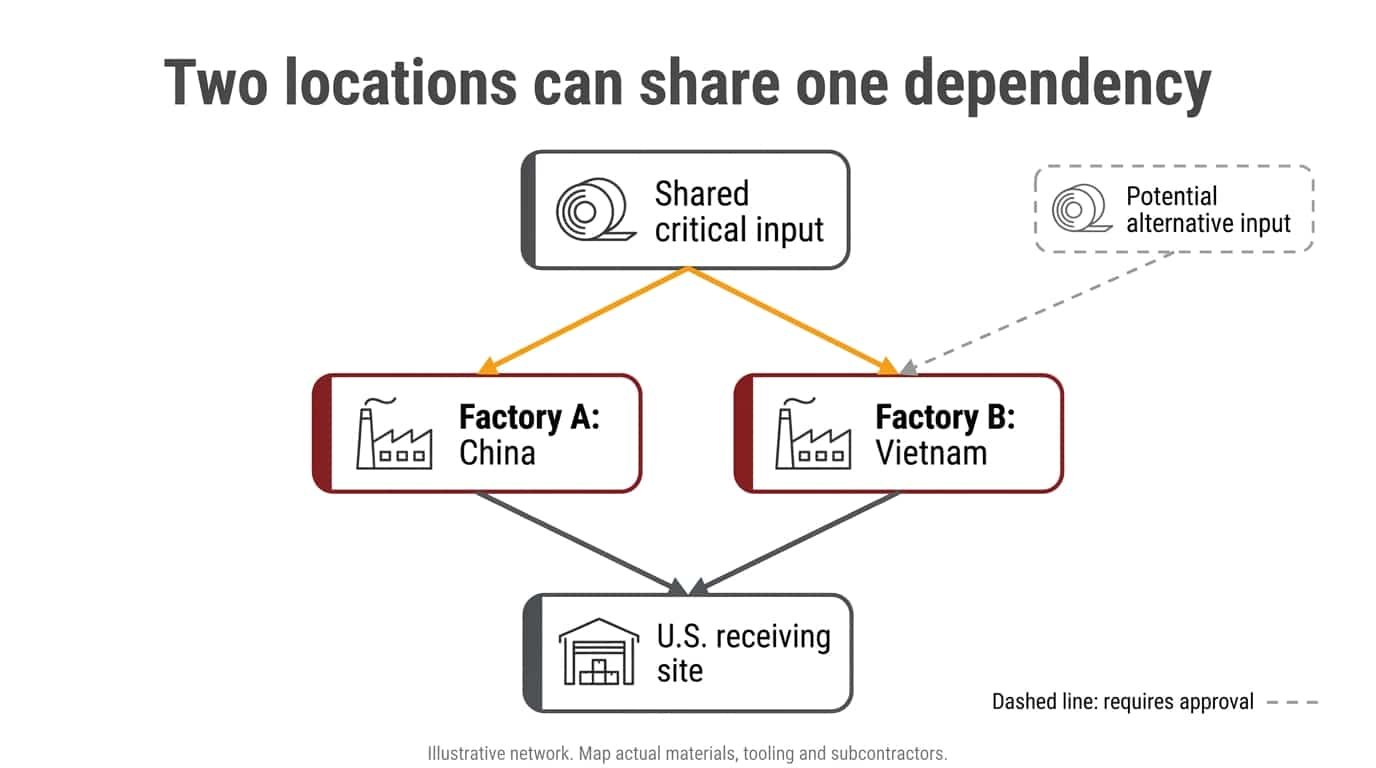
Map the critical inputs for the selected part family. Identify where substitutes exist, whether they are approved and who can authorize a change. Include unique tooling and buyer-specified components, even when they represent little spend: a low-cost component can stop an expensive assembly.
This is a practical inference for supplier selection, rather than a finding about any particular Vietnamese factory. Country diversification can reduce some exposures while leaving others intact. State which risks the proposed arrangement actually addresses.
For 2027 planning, set review triggers around those dependencies. A change of mill, subcontractor, ownership or manufacturing route should prompt a review of the relevant technical, commercial and import assumptions. An alternative source remains useful only if its documented capability and input network stay current.
Choose between keeping adding and moving
Use the following comparison sheet for the actual suppliers under consideration. These are evaluation questions, not country rankings.
| Decision factor | Evidence to compare |
| Product fit | A credible process route for the same drawing and material |
| Supplier depth | Named sources for critical inputs and outside processes |
| Quality | Part-specific results, measurement methods and corrective actions |
| Volume fit | Batch economics and capacity at the limiting operation |
| Economics | Comparable recurring cost and separately identified launch cost |
| Delivery | Defined lead-time stages, assumptions and recovery arrangements |
| Engineering support | Revision ownership, technical response and escalation routes |
| Independence | Common inputs, tooling and logistics dependencies that remain |
Keep the current source when the switching case is weak
Retention can be a deliberate strategy. In an illustrative complex-assembly scenario, the incumbent has working tools, approved specialist processors and demonstrated delivery performance. Demand is modest, the design is still changing, and a new source would require substantial revalidation. If the expected benefit cannot support that burden, retaining production while addressing specific incumbent risks may be the stronger decision.
Avoid treating retention as “do nothing.” Agree on improvements, verify capacity and review the dependency map. Record what would cause the decision to change.
Add Vietnam as a qualified second source
Dual sourcing can be appropriate when continuity or additional capacity justifies maintaining another approved route. In an illustrative welded-frame program, the buyer might qualify a Vietnamese supplier while keeping the existing Chinese supplier active. The case depends on compatible output, sufficient demand for both and an allocation model each can support.
Budget for duplicated qualification, tooling where needed, revision control and ongoing supplier management. An approved supplier receiving no orders may not retain the material, people or production familiarity needed for rapid recovery. Define how readiness will be maintained and verified.
Move selected part families when the evidence supports it
For an illustrative stable bracket family, a candidate may demonstrate the required material, forming and finishing route, produce acceptable samples and establish a credible commercial case. That can justify a controlled transfer of the family, subject to production approval and a continuity plan.
It does not establish that adjacent products should move automatically. Review their own processes, tooling and customer requirements. The next step is [planning a first production transfer to Vietnam], with explicit approval gates and a decision on when allocation can increase.
Document the recommendation in one page: preferred option, evidence, unresolved conditions, incremental investment and the next decision date. Procurement, engineering, quality and operations should be able to explain the same rationale.
For a 2027 program, also record when the decision must be made to protect the required delivery date. Work backward from the buyer’s actual approval dependencies, including any end-customer acceptance. If a critical condition remains unproven at that point, defer the allocation change or retain overlap while the evidence is completed. Calendar pressure should change the contingency plan, not lower the acceptance standard. A sourcing strategy becomes executable when its conditions, owners and decision dates are as clear as its expected benefits.
Frequently asked questions
No. The result depends on the part, supplier, order pattern and comparison boundary. Material, tooling, production efficiency, freight, import obligations and inventory can outweigh a wage difference. Compare a realistic first-year case and an ongoing-production case. A lower quotation is worth investigating, but it becomes a sourcing advantage only when the requirements and cost assumptions are aligned.
That is not a useful objective for most product portfolios. Each supplier may support different technologies, tooling, specialist processes and approved components. Evaluate those needs by part family. A sound portfolio decision can retain some Chinese production, qualify Vietnamese alternatives for other products and defer transfers whose technical or commercial case remains incomplete.
No. The new factory may purchase materials, tools or components from existing upstream networks. Review critical inputs and approved alternatives, including dependencies shared with the incumbent. The important measure is the exposure reduced by the second source. A different factory address is relevant, but it does not by itself establish an independent production route.
When the value of additional capacity, continuity or flexibility supports the cost of keeping two sources ready. Include qualification, tools, smaller order quantities and management effort. Consider the impact of an interruption and whether the alternative can respond under the relevant conditions. Agree on an allocation and readiness-review process before describing a supplier as a backup.
Start with the current drawing, material specification, volume profile, acceptance requirements and actual incumbent performance. Then request a proposed process route, comparable commercial assumptions and an explanation of critical dependencies. NIST MEP’s supplier-selection guidance supports a structured assessment of suppliers rather than a price-only decision. Identify missing evidence before commissioning a broader evaluation.
Review one product family
To discuss sourcing options with VNO, bring one representative part family, the latest drawing revision, expected annual and batch quantities, and the reason for reviewing the current arrangement. Include any customer approvals, material restrictions or delivery commitments that cannot change.
The first discussion should establish which option deserves further work: improve the existing arrangement, evaluate a second source or assess a selective transfer. From there, the team can identify the evidence and cost assumptions needed for a decision. A clear product brief makes that conversation more useful than a general request to find a cheaper country.
