

A supplier quotes $36 for a fabricated assembly. Your current source charges $42. The difference looks promising until the new quotation excludes export packing, assumes larger production batches, and leaves inspection and freight for the buyer to arrange. Another supplier offers a higher price with several of those services included. Comparing the headline numbers would reward different scopes of work.
For a U.S. manufacturer evaluating Vietnam after FABTECH, the useful question is what it will cost to receive usable, approved parts at the required rate. That calculation connects the factory quote with logistics, import charges, inventory, quality and the work needed to establish a new source.
This guide provides a practical cost model for 2026–2027 sourcing decisions. It separates recurring economics from launch spending and shows which assumptions can reverse an apparent saving. For the broader decision, start with our [Vietnam manufacturing sourcing guide].
Define what your quote includes
Agree the delivery boundary
Begin with a named receiving location, such as your U.S. plant’s receiving dock. Every option must reach that same point in the comparison. A price at the supplier’s premises cannot be compared directly with a delivered price simply because both are expressed in dollars per piece.
Record the selected Incoterms rule, named place and edition in full. The International Chamber of Commerce’s Incoterms 2020 rules allocate specified delivery obligations, costs and risks between buyer and seller. They do not replace the rest of the purchase contract. Payment terms, acceptance, ownership of goods, warranty and remedies still need agreement.
Also separate the point where risk transfers from the destination to which transport is paid. The ICC Academy’s January 2026 explanation of C and D rules describes why those points can differ. A freight-inclusive price does not automatically mean the seller retains transit risk until your plant receives the goods.
Normalize the commercial assumptions
Use a short comparison sheet before judging price competitiveness.
| Input | What each supplier must confirm |
| Product specification | Drawing revision, material, finish and acceptance requirements |
| Quantity | Annual demand, release quantity, minimum order and price breaks |
| Delivery | Incoterms rule, named place, transport mode and destination |
| Currency | Quote currency, conversion assumption and price adjustment mechanism |
| Validity | Expiry date and conditions that trigger repricing |
| Tooling | Separate charge, ownership, maintenance and replacement responsibilities |
| Payment | Deposit, milestones, balance timing and credit terms |
| Exclusions | Testing, packing, inspection, handling and other omitted services |
Annual demand and batch size deserve separate fields. A supplier may price 10,000 pieces per year on the assumption that it can manufacture all 10,000 in one run. Your requirement might be ten releases of 1,000 pieces with design changes between them. Setup utilization, storage and cash commitments would then be materially different.
Ask whether tooling is paid separately or recovered through the piece price. If recovery is included, clarify when that component ends. Establish who can authorize repairs and whether you can retrieve the tool. A low quoted tooling charge offers limited value if maintenance, replacement or access conditions are unclear.
Separate landed cost from total cost of ownership
Set a consistent landed cost boundary
For this article, landed cost means the recurring cost of purchasing and bringing conforming goods to the agreed receiving point. It includes the product, separately charged inspection and packing, transport, insurance, handling, applicable duties and fees, and customs brokerage. Your company may use another definition; consistency across alternatives matters more than the label.
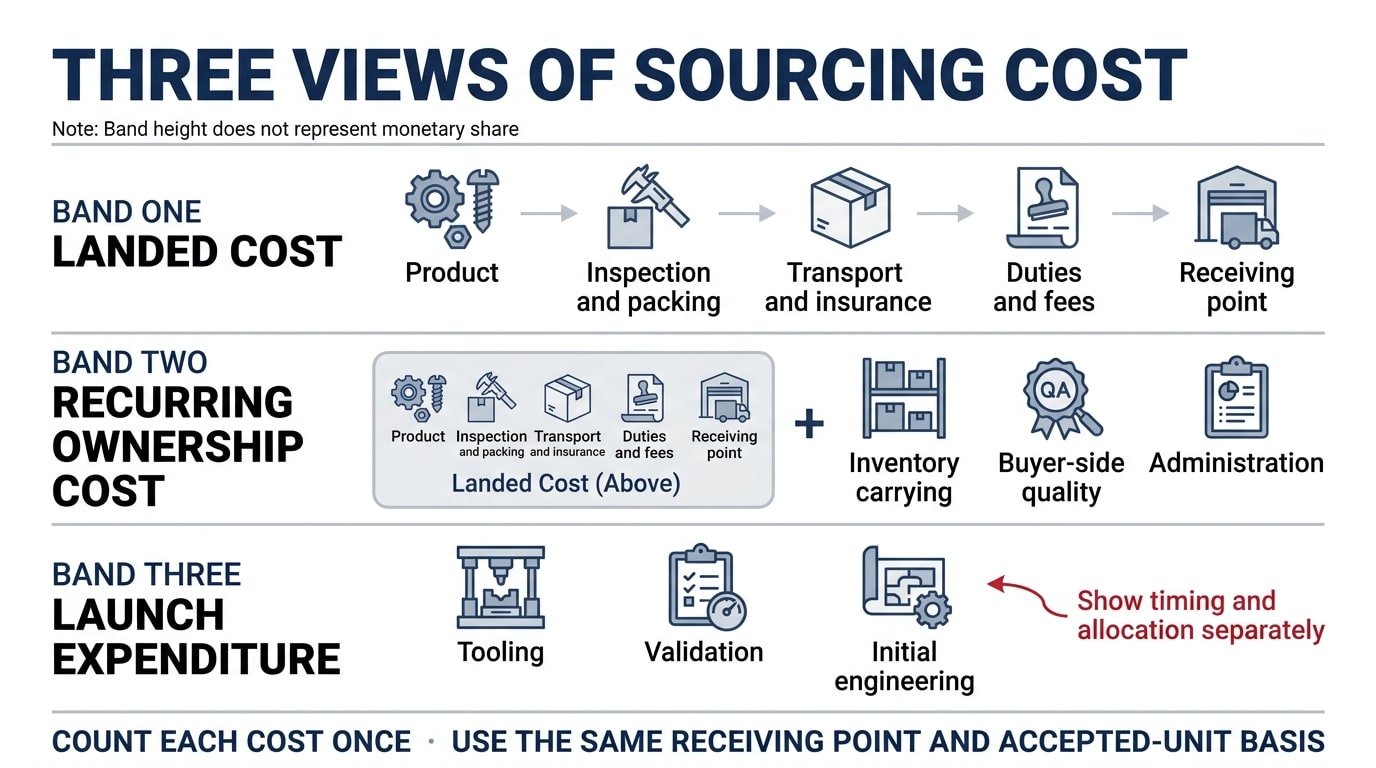
Total cost of ownership adds the operating consequences of using the source. These may include inventory carrying costs, buyer-side quality losses, supplier administration and engineering support. Launch spending is then shown separately so managers can see both the ongoing result and the initial investment.
Use three lines in the business case:
- Recurring landed cost per accepted unit.
- Recurring ownership cost per accepted unit, including the additional operating allowances.
- First-year modeled cost, including separately identified launch expenditure.
The denominator needs attention. Purchased pieces and accepted pieces are not always the same quantity. If a model assumes 10,000 usable parts, any extra purchases needed to deliver that quantity must appear in the cost. Avoid both ignoring that loss and charging it again through a separate scrap allowance.
Keep launch spending visible
Tooling, fixtures, sample production, validation and initial engineering can create a large difference between the first year and later years. Show the cash requirement when it occurs. If you also allocate that spending across production for decision-making, label the allocation and avoid adding it twice.
Customs valuation is a separate calculation. Certain buyer-provided tools or other assists may affect the value used for import assessment under 19 CFR 152.103. That does not mean the buyer purchases the tool twice. Record the commercial expenditure once, then account separately for any resulting import charges using the applicable valuation treatment.
An attractive recurring cost can justify a measured launch investment. It cannot justify an allocation based on volumes that the business has little reason to expect. Use an approved planning horizon and expose the result at lower demand.
Build the cost model line by line
Material and conversion
The product price should correspond to the approved material grade, dimensions and process route. A substituted material, different coating thickness or omitted machining operation changes the product being priced. Engineering should close those gaps before procurement treats the quotation as comparable.
Request enough cost separation to understand material exposure and conversion assumptions. A supplier may reasonably protect its detailed costing, but the buyer still needs to know what triggers a price change. Define whether an adjustment follows a named material index, an agreed review interval or a documented supplier input change.
Inspection and packaging
Separate normal production control from buyer-requested additional inspection. Identify who pays for initial dimensional reports, laboratory tests, independent inspection and repeat checks following a failure. An inspection charge has meaning only when the sampling plan, characteristics and reporting scope are known.
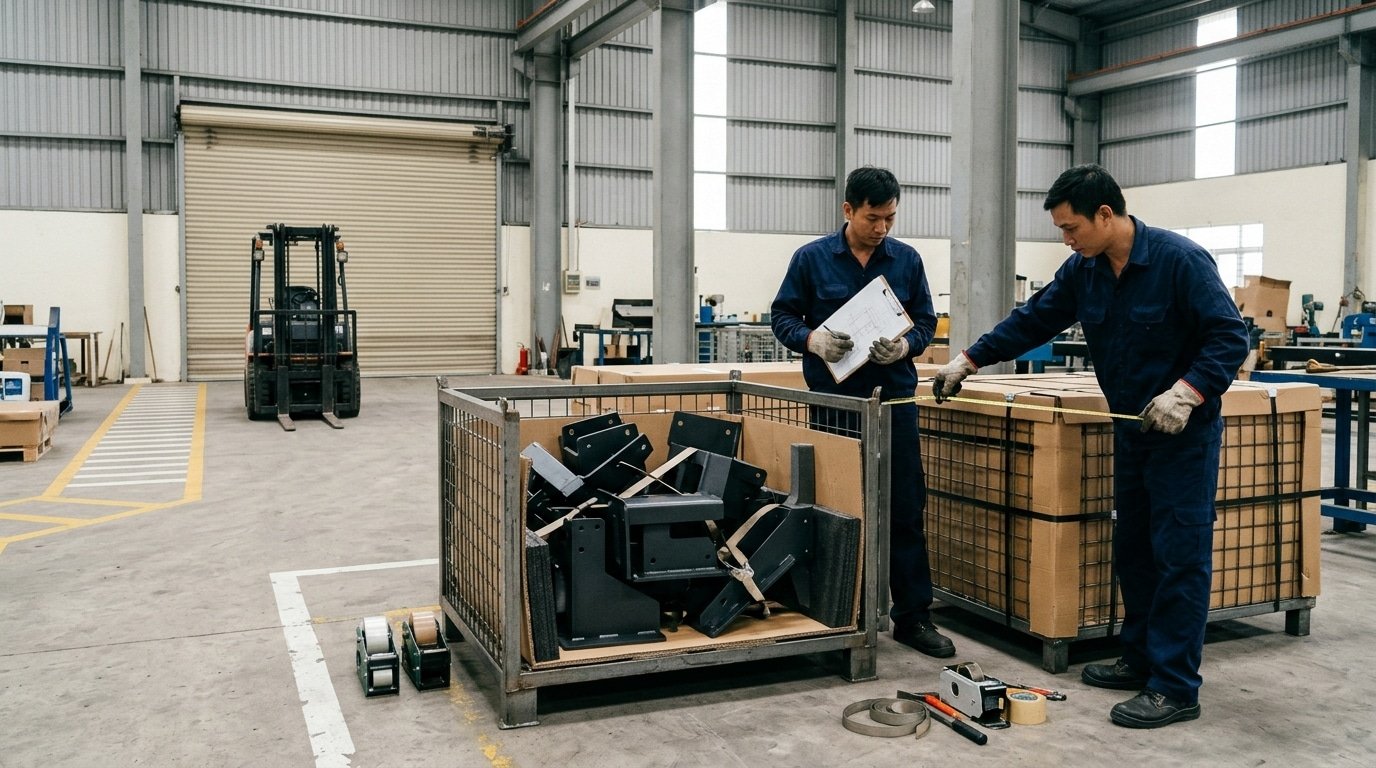
Packing also affects the economics after dispatch. Corrosion protection, part separation, lifting access and restraint must fit the product and route. A welded frame shipped with inefficient nesting may use more container space than a heavier but better-designed shipment. Compare packed dimensions, gross weight and actual load plans, rather than allocating freight by product value alone.
Transport and import costs
Ask the logistics provider for a dated quotation that states the route, mode, chargeable weight or volume, validity and exclusions. Check origin handling, international freight, insurance, destination handling, inland delivery and foreseeable storage exposure. Identify items already included in the supplier’s price before adding anything.
Import charges require the product’s classification, origin, customs value, applicable measures and expected entry date. Use the USITC Harmonized Tariff Schedule and current agency guidance with your customs professional. A shipping address in Vietnam is insufficient to establish the complete duty treatment. Our [guide to U.S. tariffs origin and traceability] explains the evidence needed for that review.
A specific fee update already applies to planning conducted in October 2026. CBP’s fiscal year 2027 notice sets the formal-entry merchandise processing fee minimum at $34.58 and maximum at $670.86 from October 1, 2026; the ad valorem rate remains 0.3464%. Applicability and exemptions still matter. The fee is not a tariff, and a per-entry floor or ceiling should not be treated as a flat percentage of annual purchases.
Inventory and quality
Estimate inventory from the actual replenishment plan: production cycle, transit, receiving time, order quantity and buffer policy. Finance should supply the carrying-rate assumptions. Separate the cash tied up in stock from the annual cost of financing and holding it. Adding the entire inventory balance as an annual expense would distort the comparison.
Quality allowances should reflect relevant evidence. Include buyer-paid sorting, rework, replacement freight and administration where applicable, net of credible recoveries. A supplier’s promise to replace a rejected part does not necessarily cover the buyer’s entire disruption cost. Use [our Vietnamese manufacturer qualification guide] to identify the process evidence needed before reducing a provisional quality allowance.
Give each model input an owner, unit, currency, date and source. Procurement owns commercial scope, engineering confirms specification equivalence, quality reviews loss assumptions, logistics verifies shipment inputs and finance checks cash and cost treatment. Unconfirmed amounts should remain visible as assumptions.
Work through a transparent example
Compare the same product and demand
The following example is hypothetical. It is not a VNO customer case, a Vietnam market benchmark or a statement of current tariff rates. It compares an incumbent source with a proposed Vietnam source for the same approved assembly, at 10,000 accepted units annually, delivered to the same U.S. plant.
All figures are U.S. dollars per accepted unit. Packing is included in the factory price. The import line is an illustrative all-in dollar input; an actual project requires a separate calculation for its shipment structure and applicable rules. The example assumes any valuation effects of tooling are already reflected in that input.
| Recurring cost item | Incumbent | Vietnam candidate |
| Factory price including packing | $42.00 | $36.00 |
| Separately charged inspection | $0.50 | $0.80 |
| Origin handling international freight and insurance | $3.00 | $3.50 |
| U.S. inland delivery | $1.50 | $1.50 |
| Duties fees and brokerage assumption | $4.00 | $5.00 |
| Recurring landed cost | $51.00 | $46.80 |
| Inventory carrying allowance | $0.80 | $1.20 |
| Buyer-side quality allowance | $0.60 | $0.90 |
| Ongoing sourcing administration | $0.40 | $0.60 |
| Recurring ownership cost | $52.80 | $49.50 |
The candidate’s factory price is $6.00 lower, but its recurring ownership advantage is $3.30 per accepted unit. Higher inspection, logistics, import and operating allowances absorb part of the quoted difference. That is the amount available to recover launch spending under these assumptions.
Show the launch investment
Assume the candidate requires $18,000 in incremental launch expenditure: $9,000 for tooling, $6,000 for validation and $3,000 for engineering. The incumbent requires no comparable incremental launch expenditure. These are illustrative commercial costs, not accounting depreciation instructions.
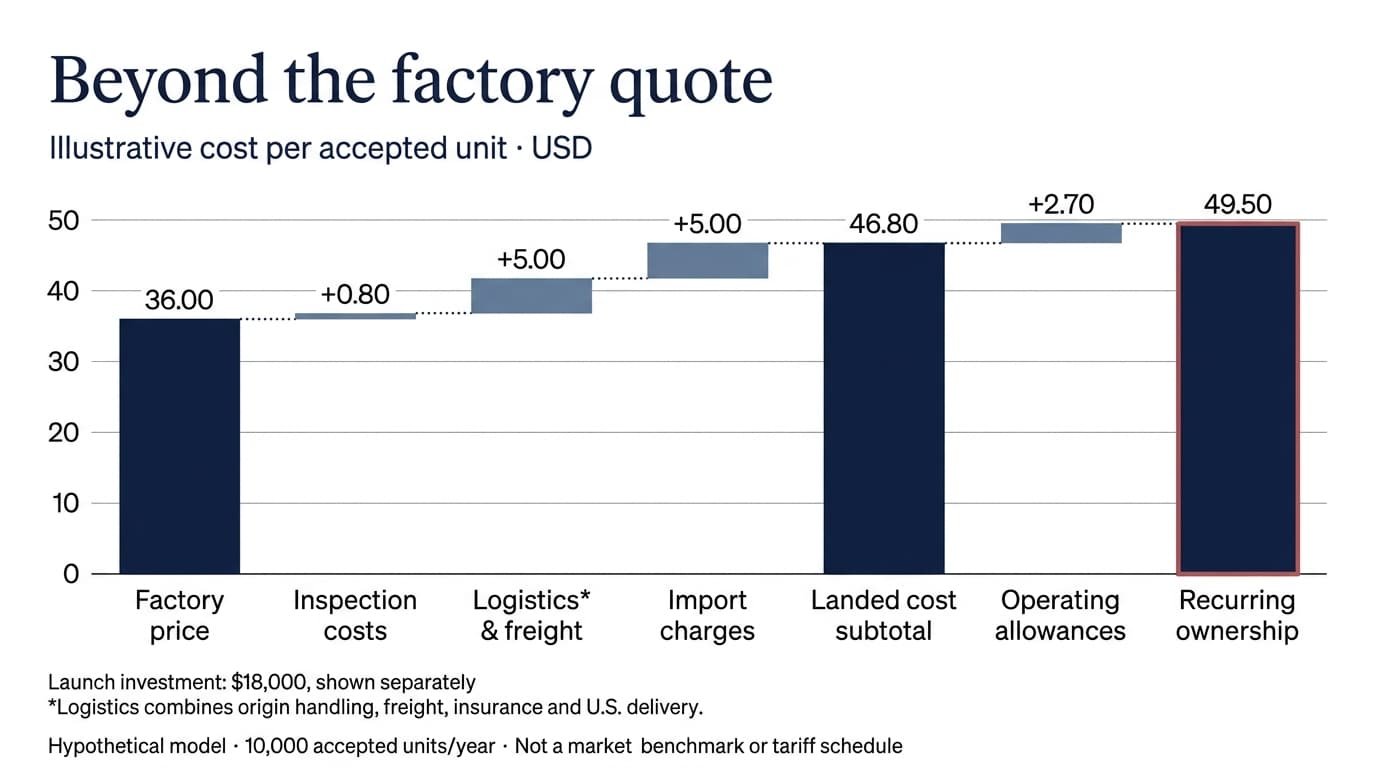
At 10,000 units, the incumbent’s annual modeled cost is $528,000. The candidate’s recurring cost is $495,000; adding the $18,000 launch expenditure produces a first-year total of $513,000. The first-year advantage is therefore $15,000, while the ongoing annual advantage is $33,000 if demand and all recurring assumptions remain unchanged.
This distinction helps management evaluate the proposal. A buyer reporting only the $60,000 factory-price difference would overstate the modeled first-year benefit by $45,000. A buyer charging the tooling allocation again after including the full launch investment would understate it.
The example also excludes a separate allowance for exceptional production interruption. A real business case should disclose such exposure and decide whether it can be quantified credibly. Do not hide a speculative shutdown estimate inside an apparently precise unit cost.
Test the assumptions that could reverse the decision
Volume and launch recovery
Under the example’s simplified assumption that recurring per-unit costs remain constant, recovering the $18,000 launch expenditure requires approximately 5,455 accepted units: $18,000 divided by the $3.30 recurring advantage, rounded up. That threshold is a model result, not a supplier commitment.
At 5,000 units, the incumbent costs $264,000. The candidate costs $247,500 plus $18,000, or $265,500. The candidate is then $1,500 more expensive in the first year. The launch allocation has increased from $1.80 to $3.60 per unit.
In practice, lower demand may also change batch efficiency and freight utilization. Requote those inputs where necessary instead of assuming that every variable scales perfectly. The useful threshold is one that reflects the quantities your organization may actually order.
Freight and import exposure
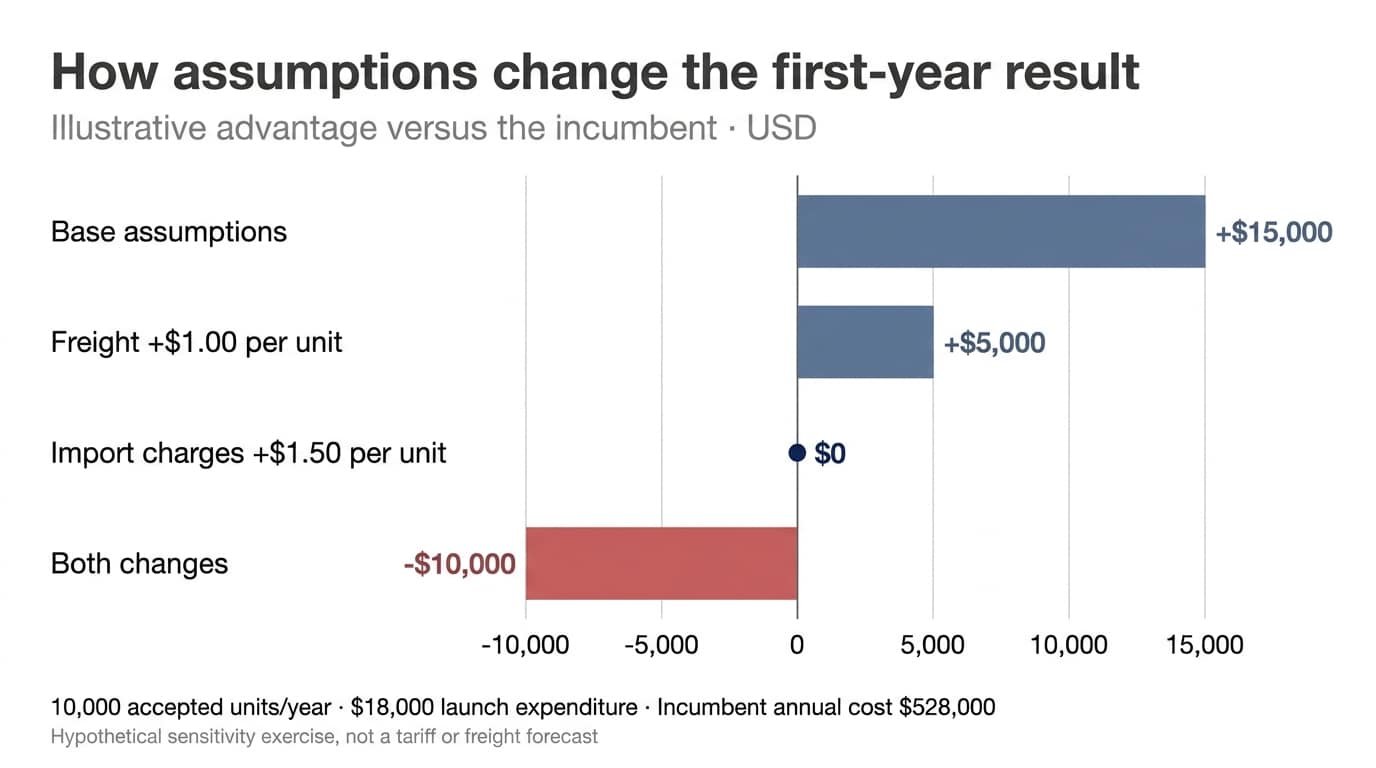
The table below changes only the stated candidate input at 10,000 units. It is a sensitivity exercise, not a prediction of freight or policy changes.
| Candidate scenario | First-year modeled cost | Advantage versus $528,000 incumbent |
| Base assumptions | $513,000 | $15,000 |
| Freight rises $1.00 per unit | $523,000 | $5,000 |
| Import charges rise $1.50 per unit | $528,000 | $0 |
| Both changes occur | $538,000 | Minus $10,000 |
A narrow cost advantage deserves closer scrutiny when an unresolved input could consume it. Record what must be confirmed, by whom and before which approval. For the strategic implications of retaining both sources, see [Vietnam versus China manufacturing].
Quality and working capital
Test quality exposure independently. In the example, an additional $0.75 per unit of buyer-side quality cost adds $7,500 annually and halves the first-year advantage. That exercise can help justify better process validation; it cannot establish a predicted defect rate for an untested supplier.
Payment and inventory assumptions also affect cash. A larger deposit or additional stock may increase funding needs even when recurring ownership cost falls. Present the peak cash requirement alongside the annual cost result. Where the quote is in dollars, do not automatically apply currency movements to the whole price: first check the contractual adjustment mechanism and which cost components are exposed.
Prepare an RFQ that produces comparable answers
Provide a controlled technical package: current drawings, bill of materials where relevant, required material and finish, critical characteristics, inspection expectations and packaging requirements. Include annual demand, release sizes, destination and delivery windows. Flag assumptions that are provisional so suppliers can price alternatives explicitly.
Require the response to identify deviations and exclusions. A blank cell should not silently become an inclusion. Separate tooling and other non-recurring engineering charges from piece prices, state quote validity, and request lead times for material procurement, samples and repeat production.
Then reconcile the quotation with the production proposal. If the supplier plans to outsource coating, establish how transport, inspection and rework between facilities are covered. If the freight model relies on a particular packing density, confirm that the proposed packaging can deliver it without damaging the parts.
The commercial comparison should culminate in a review with engineering, quality, logistics and finance. Track each unresolved item to a named owner and due date. Our [guide to choosing a first Vietnam transfer project] connects this RFQ work with a controlled sample, pilot and production launch.
Frequently asked questions
Define it at an agreed receiving point. Typically, the model combines the product and separately charged inspection or packing with transport, handling, insurance, applicable import charges and brokerage. Identify what is already in the quote. Inventory carrying costs and buyer-side operating losses can then be shown separately within total cost of ownership.
Show the actual tooling payment and timing first. For economic comparison, divide the relevant launch investment across a defensible production quantity or planning horizon. Test lower demand and avoid counting both the full payment and its allocation in the same total. Customs valuation treatment requires its own review.
A lower factory price may accompany larger minimum orders, greater freight usage, additional inspection, longer cash exposure or more launch spending. Compare accepted units at the same destination and specification. A quotation difference becomes a sourcing advantage only after the additional costs and required investment are accounted for.
The shipping country alone is insufficient. Confirm the imported product’s classification, origin facts, customs value, applicable trade measures and entry date. Use a documented assessment for the actual product. A general country percentage can produce the wrong cost, particularly when specific product provisions or exceptions apply.
Refresh supplier pricing at its validity date and after specification or volume changes. Recheck logistics quotations when route, packing or booking assumptions change. Review import treatment for the expected entry date, and replace provisional quality and inventory allowances with relevant operating evidence as the source becomes established.
Review the assumptions behind your quote
A useful sourcing discussion starts with a defined assembly and a comparable set of commercial assumptions. Share your drawing revision, expected demand, release quantity, delivery terms and U.S. destination with VNO to discuss the missing inputs and next steps. A clear model helps your team decide whether to qualify a Vietnam source, retain the incumbent or develop a second source with a measured commitment.
