

FABTECH 2026 gives industrial buyers a useful setting for reviewing how they select suppliers for the year ahead. Alongside metal forming, fabrication, welding and finishing, its published conference program addresses regionalized supply chains and how fabrication shops are chosen in 2027. The official session agenda connects sourcing decisions with distribution, supplier concentration and the evidence buyers use to identify suitable shops.
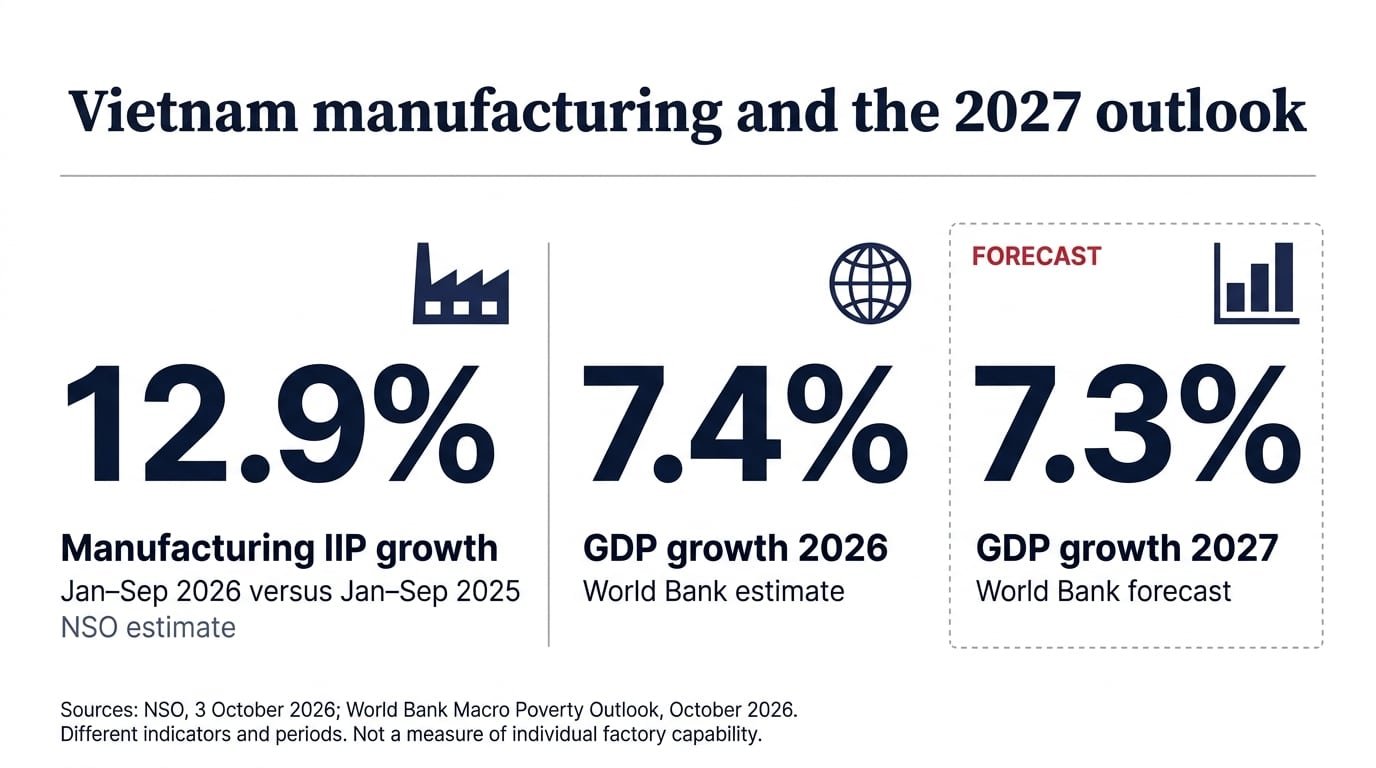
Vietnam belongs in that discussion. The National Statistics Office estimates that manufacturing production increased 12.9% year on year in the first nine months of 2026. That is a positive signal of industrial activity, although it does not establish the capability or available capacity of any individual supplier. For a U.S. buyer following up after FABTECH, the opportunity is to turn interest in Vietnam into a specific sourcing assessment: which parts fit the supplier base, what qualification will require, and whether the economics remain attractive after delivery and import costs.
This guide focuses on industrial components and assemblies, including fabricated metal parts, welded structures, machined components and castings. It provides a sequence for evaluating Vietnam, from selecting a product family to approving a production source. The most useful starting point is a defined manufacturing requirement and a clear reason for considering a new supplier.
What US buyers need to know first
When Vietnam deserves a closer look
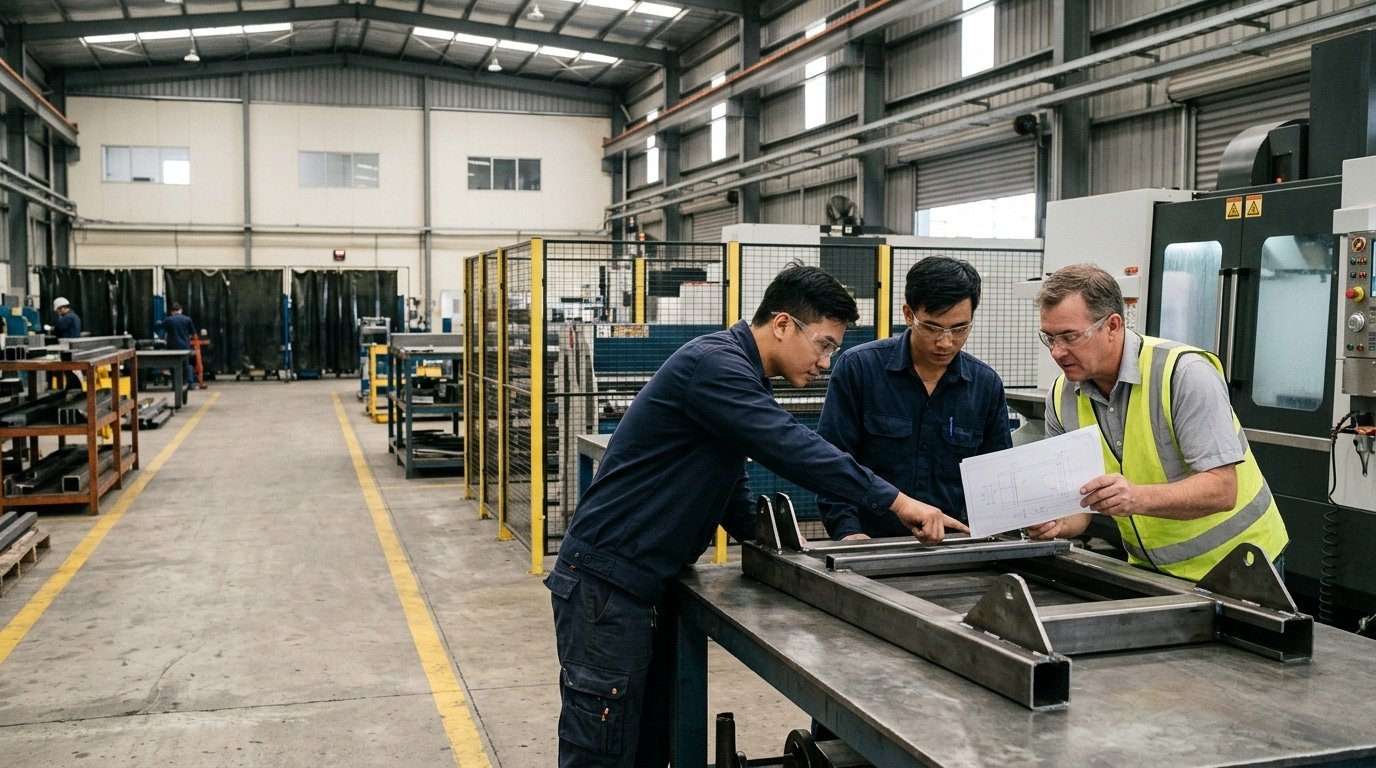
Vietnam merits investigation when a buyer can identify a plausible match between a product and the processes available at candidate factories. A recurring fabricated assembly with established drawings may offer a manageable starting point. A product that still needs major design changes, customer approval or an unresolved material substitution requires more preparation before supplier quotations become meaningful.
The business objective also matters. Creating a second source, finding capacity for growth and replacing an underperforming supplier are different projects. They require different comparisons, investment decisions and measures of success. A second source can be valuable without receiving most of the volume. A transfer intended to reduce cost needs a convincing financial case after launch investment and the costs of maintaining supply during the transition.
What must be verified before a sourcing decision
Before requesting a broad supplier search, answer these six questions:
- Is there a controlled drawing, specification and bill of materials for the product?
- Can engineering identify the dimensions, material properties and functions that determine acceptance?
- Is the expected annual demand credible, with a realistic release pattern and batch size?
- Does the organization have time and resources to qualify samples and production processes?
- Can the buyer identify its receiving destination, import responsibilities and delivery constraints?
- Is there an agreed business reason for adding or changing the source?
Missing information need not stop an initial conversation. It should change its purpose. For example, an early feasibility discussion can identify material availability and manufacturing questions before a formal request for quotation. Treating an incomplete brief as a firm production specification usually creates a low-confidence price and avoidable rework.
Understand the manufacturing base behind your product
Industrial processes and supplier ecosystems
Vietnam’s manufacturing activity spans different industries, ownership structures and levels of technical capability. National growth figures help establish economic context. The NSO September 2026 industrial production release reports the nine-month manufacturing increase cited above; it should not be read as a supplier qualification result.
For metal fabrication, examine the complete process route. Laser cutting and bending may be straightforward parts of a drawing, while weld distortion, access for finishing, thread protection or final assembly alignment determine whether the delivered product works. A supplier’s machine list provides an initial filter. Production examples, process controls and inspection records establish whether that equipment is being used effectively for comparable work.
Machined components require a similarly specific assessment. Consider the material condition, workholding, datum structure, access to features and the sequence of machining and finishing. A factory might produce a component’s general shape but struggle to maintain relationships between features after heat treatment or coating. Ask how the proposed route protects those relationships and how conformity will be measured.
Cast components introduce additional dependencies, including tooling ownership, casting quality, machining allowances and treatment of defects. The organization quoting the finished part may control some operations and subcontract others. That arrangement can be workable when responsibilities, approved sources and inspection requirements are clear. A single commercial contact does not necessarily mean a single manufacturing site.
Location and upstream dependencies
A useful factory map follows the material and the product. Identify where stock is purchased, where outside processes take place, where inspection is performed and how packed goods reach the export gateway. The nearest port is only one consideration. Moving parts repeatedly between subcontractors can add handling, damage exposure and uncertainty even when the final factory is close to a shipping terminal.
JETRO’s FY2025 survey, published in English in 2026, reported local procurement of 38.1% for its manufacturing respondents in Vietnam and 71.0% in China. These are Japanese-company survey results, not customs origin percentages. The survey publication provides the methodology and report.
For a buyer, the practical follow-up is to identify dependencies within the actual product route. A local assembly operation may still depend on imported alloy stock, a proprietary component or an overseas toolmaker. Evaluate whether those dependencies are acceptable, how they affect replenishment, and which alternatives could be qualified if supply changes.
The [Vietnam manufacturing landscape] article examines industrial ecosystems and process fit in more detail. Use it to structure a shortlist, then validate the proposed factory and its subcontractors against the requirements of your own product.
Decide where Vietnam fits in your sourcing strategy
A new source for a new requirement
For a new product, Vietnam can be evaluated alongside other locations before tooling and process assumptions become difficult to change. This gives engineering an opportunity to clarify manufacturability with candidate suppliers. The buyer should retain control of design intent and approval decisions while asking suppliers to explain practical alternatives.
A proposed change to a bend radius, weld location or purchased material size may improve manufacturing efficiency. It can also affect fit, durability or interchangeability. Record the proposal as an engineering question, assess its effect on the product, and approve any drawing revision before treating the revised design as the commercial baseline.
A qualified second source
Adding Vietnam as a second source can provide an alternative production location and help accommodate demand growth. The benefit depends on what is genuinely independent. Two final factories that rely on the same critical material supplier may share a major disruption risk. Two tools that require maintenance by the same unavailable specialist may offer less redundancy than the purchasing system suggests.
There are also operating costs to maintaining a second source. Both factories need current revisions and sufficient familiarity with the product. Dividing volume can change minimum quantities, material pricing and scheduling priority. Establish how much work each source needs to remain usable, and test the arrangement through actual releases rather than assuming that an approved supplier can restart immediately after a long idle period.
A selective production transfer
A transfer may be appropriate when the new source demonstrates suitable capability and the financial or operating benefit justifies qualification and launch risk. Evaluate the part family rather than treating the whole purchasing category as interchangeable. A simple welded bracket and a highly integrated electromechanical assembly can have very different dependencies even when purchased from the same incumbent.
|
Sourcing approach |
A useful reason to consider it |
Evidence required before commitment |
|
New source for a new product |
Establish manufacturing fit before launch |
Feasible process route, approved specifications and launch economics |
|
Qualified second source |
Add usable capacity or reduce a defined dependency |
Independent dependencies, sustained readiness and a workable allocation of volume |
|
Selective transfer |
Improve a demonstrated cost or operating problem |
Accepted parts, repeatable production and a controlled continuity plan |
Retaining the incumbent can also be a sound outcome. If tooling cannot be moved, validation costs are high or demand is nearing the end of its life, a transfer may consume more value than it creates. The [Vietnam vs China manufacturing comparison] develops the product-level questions behind these choices.
Compare total cost on a consistent basis
Establish a common commercial baseline
Start with matching requirements. Quotes should refer to the same drawing revision, material specification, finish, inspection scope, packaging and volume assumptions. Ask suppliers to identify exclusions and proposed deviations explicitly. An attractive unit price may otherwise describe a different product or leave required work outside the quotation.
State the delivery term, its named place and the applicable rules. The ICC Incoterms 2020 framework allocates defined obligations, costs and risk between seller and buyer. It does not replace the whole purchase contract. A quotation should also make payment timing, acceptance requirements, tooling arrangements and change approval clear.
The volume baseline deserves particular attention. A supplier quoting a large annual quantity produced in a few efficient batches may appear cheaper than one allowing small, irregular releases. Compare the actual purchasing pattern your operation can support. If a larger batch reduces production cost, calculate its effect on storage, cash tied up in inventory and exposure to an engineering change.
Separate landed cost from total cost of ownership
Landed cost brings a shipment to a defined receiving point. Depending on the agreed scope, it includes product cost, relevant freight and handling, insurance, applicable import charges and delivery. Total cost of ownership extends the analysis to costs associated with operating the source, such as qualification, inventory financing, incoming inspection, expected rework and supplier management.
Keep recurring and nonrecurring costs visible. Tooling, fixtures, sample development and initial testing may be paid before the first accepted production shipment. Their allocation over expected volume can be useful for comparison, but it does not change the cash payment date. A project with uncertain demand should show what happens if fewer parts are purchased than planned.
Avoid counting the same cost twice. If packaging is included in the supplier’s unit price, it should not reappear as an additional packing line without explanation. Tooling might affect customs valuation while also appearing as a commercial investment; the model must distinguish the relevant duty calculation from the original tooling payment. Document the basis rather than hiding it inside a single landed-cost percentage.
Test the assumptions that can change the decision
Use a base case and a small number of relevant sensitivities. Change freight, duty treatment, accepted yield, order frequency or annual volume separately to understand what drives the result. If a small change reverses the sourcing decision, investigate that input before committing. A low quoted price provides little protection when the project depends on an unverified material route or unrealistic sales forecast.
The [true cost of manufacturing in Vietnam] article provides a worked, explicitly hypothetical example and a method for normalizing quotations. Its value lies in making assumptions reviewable. Actual project decisions require current supplier offers, a defined shipment plan and product-specific import analysis.
Qualify the supplier for the actual part
Verify the quality system and its scope
A quality management certificate is useful evidence about a defined organization and scope. Check the legal entity, covered site, activities, issuing body, validity and status. Match those details to the organization that will manufacture your product. A certificate for a related company or a different factory should prompt further questions about the proposed production arrangement.
ISO now identifies ISO 9001:2026 as the current edition. When reviewing an existing certificate against an earlier edition, verify the applicable transition and validity with the certification body. Edition alone does not establish whether a particular supplier is acceptable for the proposed work.
Prove the process and measurement method
The qualification plan should follow the product’s risks. For a welded assembly, review how the factory locates components, controls distortion and checks the completed structure. For a machined housing, examine how the process establishes critical datums and verifies related dimensions. Include outside processes when they can change material properties, surface performance or final geometry.
Inspection needs an agreed method. A report containing nominal values and pass marks is difficult to evaluate without the drawing revision, actual results and identification of the inspected parts. Discuss measurement fixtures, equipment suitability and how ambiguous features will be interpreted. Resolve disagreements before sample approval so that supplier and buyer are judging the same requirement.
Ask the factory to explain how records remain connected. The link between incoming material, production order, outside processing and shipment should survive the handling steps used in normal production. A system that only works when an engineer manually reconstructs the history is vulnerable as volume increases or experienced personnel are absent.
Define approval and ongoing controls
Sample approval establishes evidence about the samples reviewed. A production release should also consider the intended equipment, tooling, work instructions, staffing and subcontractors. If a pilot uses a different route from later production, identify which conclusions can legitimately carry forward and what still needs validation.
Some customers require a Production Part Approval Process package or an industry-specific first article inspection. Apply these requirements when the customer, product or governing contract calls for them. Other industrial products can use a tailored approval package that documents the same essential decisions without importing unrelated requirements.
Agree what happens after a nonconformance. Identify who can authorize a deviation, how affected stock is contained, how corrective action is verified and when production can resume. Supplier qualification should also check realistic capacity, key-person dependencies and business continuity. The [guide to qualifying a Vietnamese manufacturer] turns these questions into a practical approval sequence.
Check US import requirements before committing
Classification and origin require product facts
The country shown on a shipment document does not settle every U.S. import question. Start with a precise product description, composition, function and manufacturing route. These facts support tariff classification and the evaluation of origin and applicable trade measures. The U.S. International Trade Commission tariff schedule is the official reference for HTS provisions, including relevant Chapter 99 measures.
For U.S. marking purposes, 19 CFR 134.1 addresses country of origin and substantial transformation. There is no universal Vietnam local-content percentage that answers every origin question for every industrial product. Supplier ownership, the nationality of a manager or the port of shipment should not substitute for the relevant manufacturing facts.
Where the outcome is uncertain, collect the information needed for specialist review before the commercial commitment becomes difficult to change. A useful file identifies the inputs, their sources, the operations performed in each country and the finished article. A photograph of an export carton marked Vietnam cannot explain that manufacturing sequence.
Keep metal specific requirements and records visible
Industrial metal products can involve additional questions about the applicable trade measure, the value on which a duty is calculated and material provenance. Requirements differ by product and provision. Avoid adding a country-level headline rate to every shipment or assuming that a general metal description provides the full answer.
Make compliance responsibilities part of the sourcing plan. Identify the importer of record, the party coordinating with the customs broker, the supplier contact providing manufacturing records and the owner of the classification review. Revisit the analysis when the product, material route, supplier site or entry date changes.
The [guide to US tariffs origin and traceability] explains a dated verification workflow and the distinction between origin records, material history and separate trade-remedy questions. This work should inform the cost model and supplier approval process while there is still time to resolve missing evidence.
Move from a shortlist to an approved first production run
Prepare a usable request for quotation
The request for quotation should describe what the buyer needs and how proposals will be compared. Include controlled drawings, material and finish requirements, expected demand, release quantities, delivery destination and acceptance criteria. Identify open technical questions separately so that assumptions are visible rather than silently embedded in each supplier’s price.
Where the supplier proposes a manufacturing change, require a description of the effect on the drawing, cost and qualification plan. A sourcing coordinator can organize the exchange, but design approval remains with the authorized buyer team. Commercial urgency should not turn an unapproved suggestion into a production instruction.
Use a controlled pilot to answer specific questions
Select pilot quantities and test coverage according to the part and its risks. The purpose is to learn whether the proposed production route can repeatedly deliver acceptable parts and whether the packaging and records remain usable through shipment and receiving. A pilot that only demonstrates a hand-finished sample does not answer all of those questions.
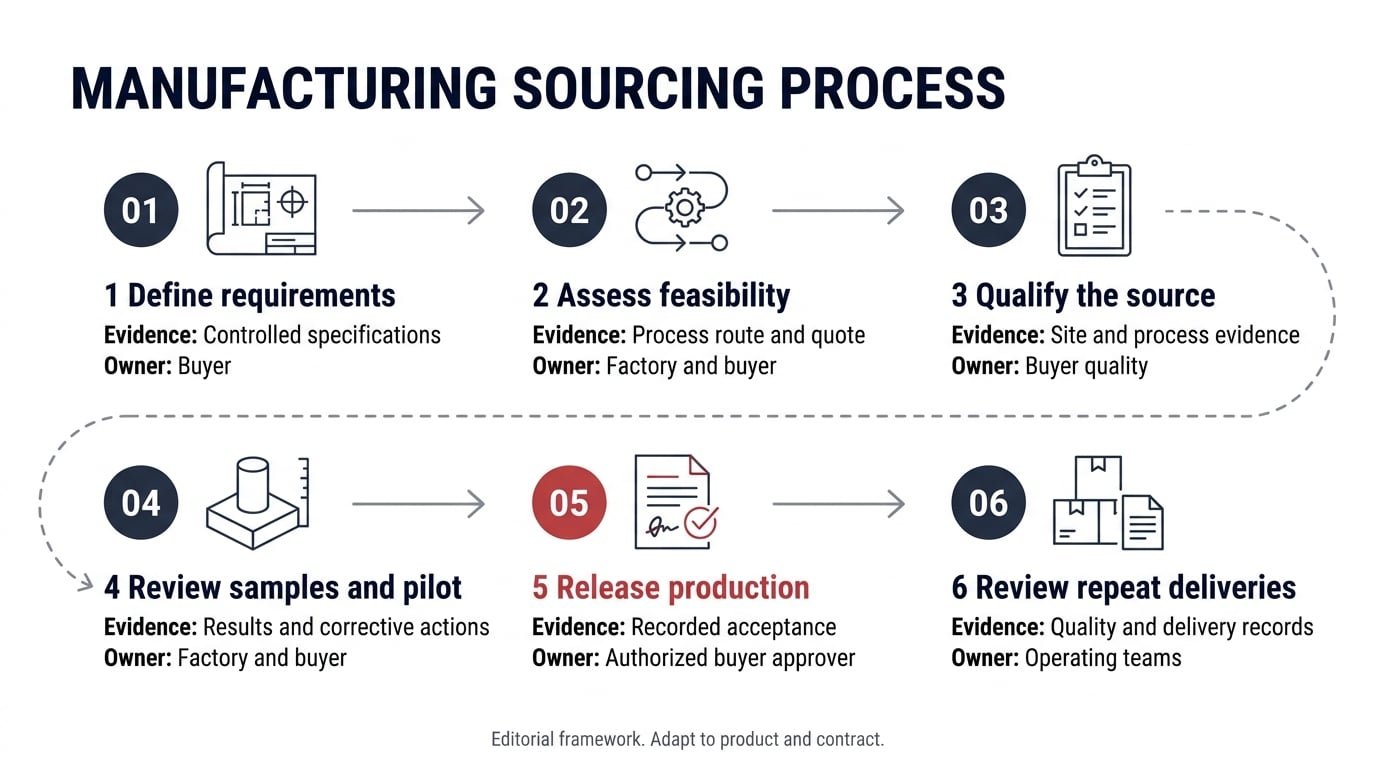
Agree the evidence required at each stage and the person responsible for reviewing it. The sequence below is a practical framework that should be adapted to the actual product and contract.
|
Stage |
Main responsibility |
Evidence or decision |
|
Define requirements |
Buyer engineering and procurement |
Controlled specifications and commercial assumptions |
|
Assess feasibility |
Candidate factory with buyer review |
Proposed route, deviations and quotation basis |
|
Qualify the source |
Buyer quality with agreed local support |
Site, process and measurement evidence |
|
Review samples and pilot |
Factory produces and buyer evaluates |
Actual results, issues and corrective actions |
|
Release production |
Authorized buyer approver |
Recorded acceptance and limits of approval |
|
Review repeat deliveries |
Buyer and supplier operating teams |
Quality, delivery and capacity performance |
Scale after the agreed conditions are met
Maintain a continuity plan while the new source proves itself. That may include incumbent supply, a defined inventory buffer and clear decisions about when allocation can increase. The appropriate arrangement depends on the consequences of a missed delivery and the time needed to recover. Avoid promising a fixed transfer timetable before technical and commercial dependencies are understood.
For the first shipments, verify receipt as carefully as dispatch. Check packaging condition, identification, quantity and the characteristics that matter to production. Feed those findings back into the source’s control plan. The [China Plus One guide to choosing your first transfer] explains how to select a manageable part family and establish release and recovery decisions for a 2027 program.
Build a sourcing plan that can adapt in 2027
Separate forecasts from operating commitments
The World Bank October 2026 Macro Poverty Outlook estimates Vietnam’s 2026 GDP growth at 7.4% and forecasts 7.3% for 2027. These figures describe an economic outlook. They do not establish next year’s factory prices, shipping costs or available machine hours.
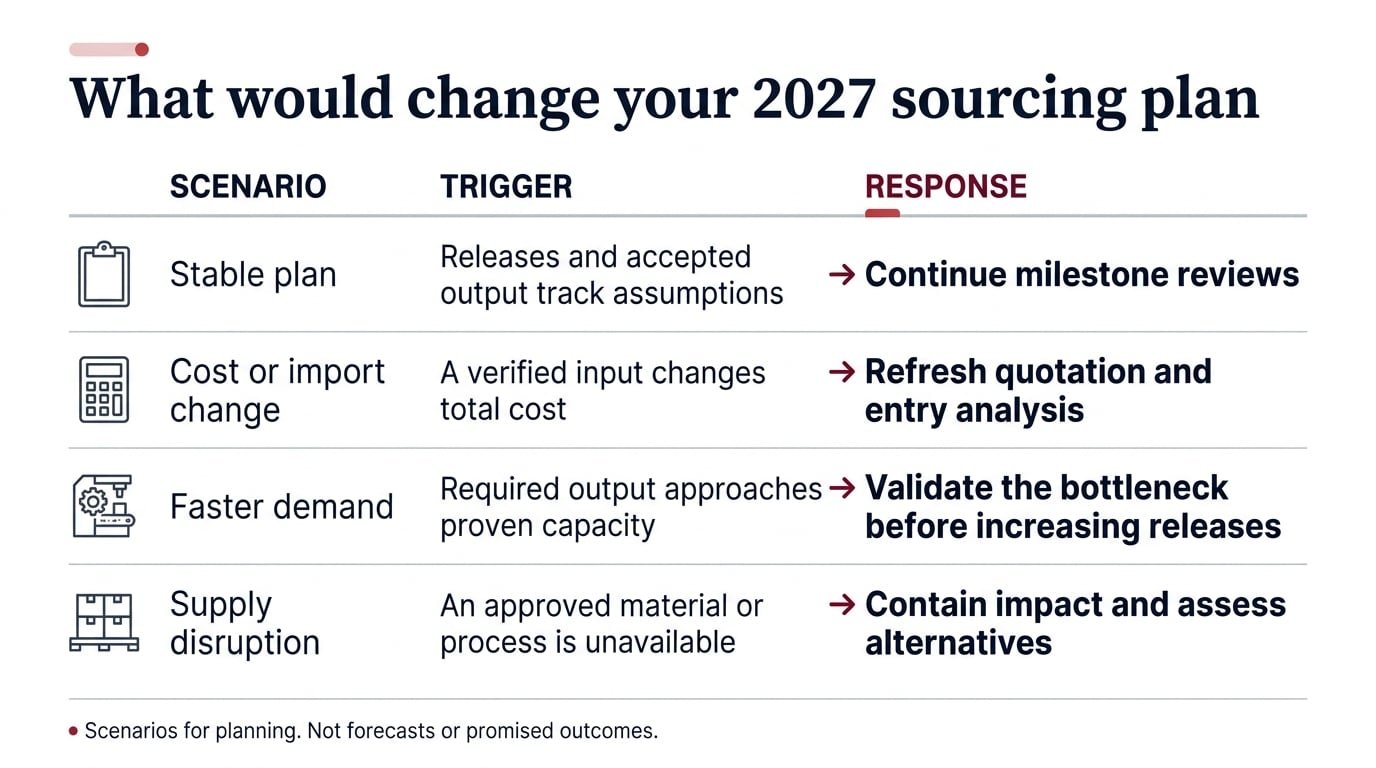
Translate planning assumptions into observable triggers. A supplier’s increasing backlog may justify reviewing capacity reservations. A material source change may require technical and origin reassessment. A revised customer forecast may change batch economics and the level of inventory that the business can reasonably hold.
Decide responses before conditions change
|
Planning scenario |
Trigger to monitor |
Buyer response to prepare |
|
Demand and costs remain near plan |
Actual releases and accepted output track assumptions |
Continue qualification and allocation reviews at agreed intervals |
|
Cost or import conditions worsen |
A verified input changes the total-cost comparison materially |
Refresh quotations and entry analysis before approving new commitments |
|
Customer demand grows faster |
Required output approaches demonstrated available capacity |
Validate the bottleneck and capacity plan before increasing releases |
|
A critical dependency is disrupted |
An approved material or outside process becomes unavailable |
Use agreed containment and assess alternatives before substitution |
Assign an owner to each trigger and define where changes will be recorded. Otherwise, procurement may update a forecast while engineering continues using an old revision and logistics plans a shipment against outdated assumptions. A simple change register with named decisions is often more useful than an elaborate dashboard that does not change anyone’s actions.
Review the sourcing case at defined milestones, including quotation approval, pilot acceptance and production allocation. Recheck it when a material assumption changes. This allows the organization to continue a sound project, narrow its scope or pause an unsuitable transfer while the options remain manageable.
