

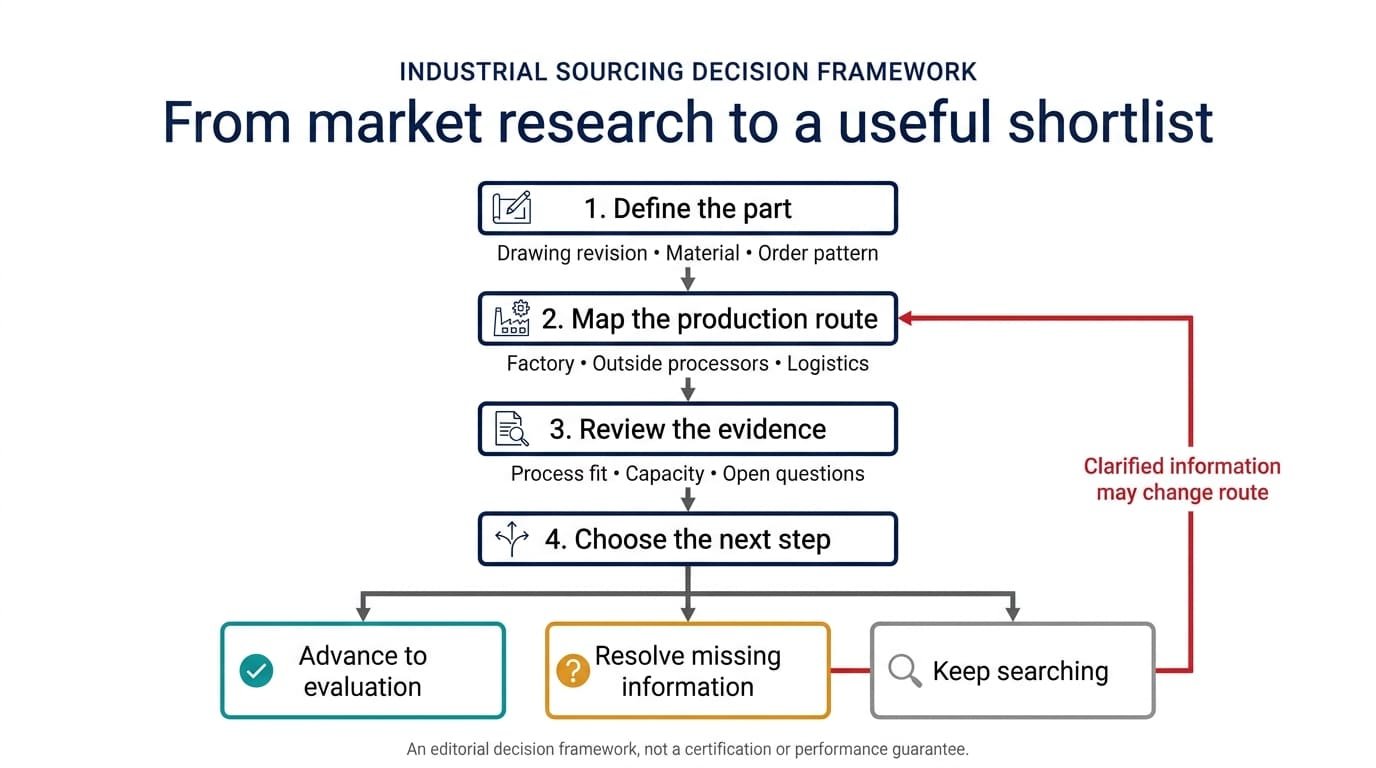
For a U.S. manufacturer considering Vietnam after FABTECH, the first useful question is specific: where can this part be made, with the materials, processes and production controls it needs?
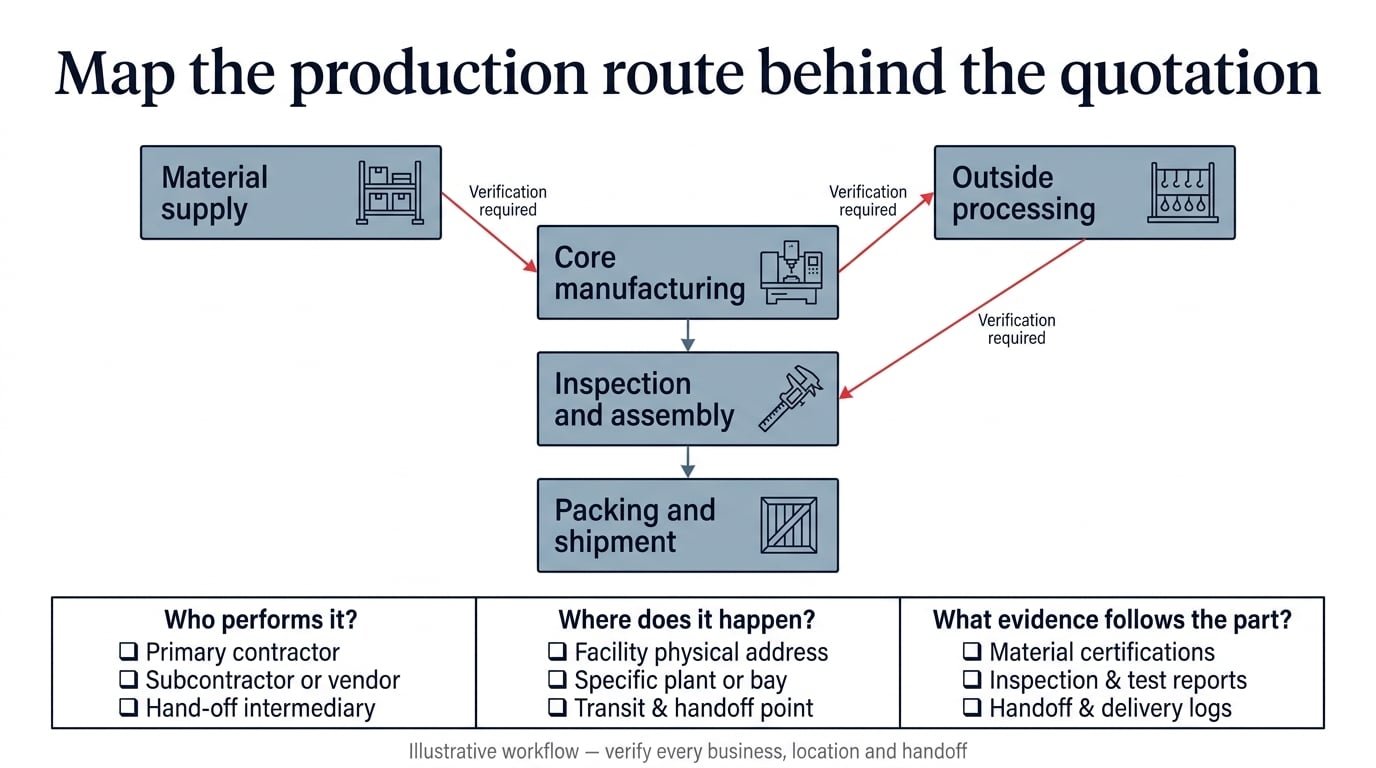
A welded machine frame, a machined housing and a finished sheet-metal enclosure may require very different supplier networks. Each can involve several businesses before a shipment leaves the country: a material distributor, a fabricator, a heat-treatment specialist, a coating company and a testing laboratory. The factory issuing the quotation is only one part of that system.
What the latest 2026 data actually shows
Industrial output and manufacturing activity
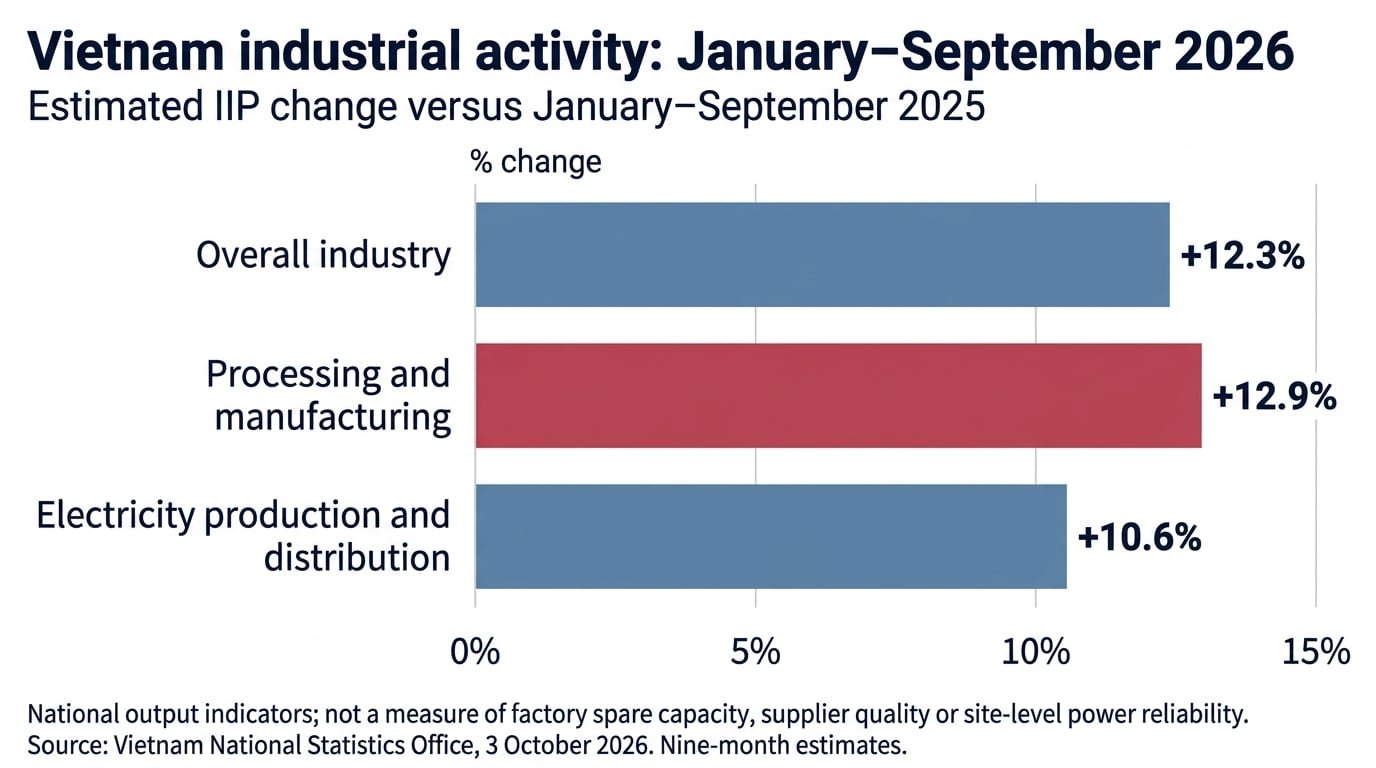
Vietnam’s National Statistics Office reported the following estimated changes for January–September 2026, compared with the same period in 2025:
| Indicator | Year-over-year change | Reference period |
| Overall industrial production index | +12.3% | January–September 2026 |
| Processing and manufacturing IIP | +12.9% | January–September 2026 |
| Electricity production and distribution IIP | +10.6% | January–September 2026 |
These figures come from the NSO industrial production release published October 3, 2026. They describe estimated changes in industrial activity. The electricity figure, for example, is an output indicator; it does not establish the reliability of the electricity supply at a particular factory.
What aggregate statistics cannot tell a buyer
Three separate questions should follow the headline figures. First, does a relevant production route exist? Second, is it available on the required commercial terms? Third, can the businesses involved demonstrate repeatable performance on the actual product?
Keep those questions separate during research. A company may own suitable equipment but have no capacity on the required shift. Another may produce excellent prototypes through a skilled technician while needing a more developed process for repeat orders.
A supplier profile should therefore record the proposed process, production location, outside services, evidence reviewed and remaining questions. That record is more useful to an engineering team than a list of factories sorted by size. It also makes subsequent discussions about [Vietnam vs. China manufacturing] more precise: both options can be evaluated against the same product requirements.
Read Vietnam through industrial ecosystems
Northern manufacturing corridors
Begin a northern search by identifying the production and logistics relationships around the Hanoi–Hai Phong corridor and the relevant surrounding industrial locations. Then narrow the search to the material and process families needed for the project.
Hai Phong’s supporting-industry program announced in July 2026 includes mechanical engineering, automotive, electronics and high-technology industries among its priorities. It also seeks stronger links between domestic suppliers and foreign-invested businesses. That makes it a useful example of the direction of regional industrial development. Its future supplier and localization targets remain plans, however, and should not be presented as existing factory capacity.
For a proposed northern supplier, establish where the material comes from, where each outside process takes place and which port service is intended. A convenient location on a map can conceal repeated transfers between workshops. Those transfers affect scheduling, handling and responsibility for work in progress.
Southern supplier and logistics networks
The wider Ho Chi Minh City industrial catchment is another sensible starting point for supplier discovery. The city’s Investment and Trade Promotion Centre program for MTA Vietnam 2026 listed participating product categories including machinery, molds, industrial components, automation, processing services and logistics. Such programs help buyers identify businesses and technical contacts for further investigation.
Use those connections to build a process-based shortlist. For a fabricated enclosure, for instance, the relevant network may include cutting, forming, welding, powder coating, bought-in hardware and final assembly. The best candidate is the one whose proposed network matches the drawing and order pattern.
Ask each candidate to identify the actual production address and proposed transport route. A sales office in Ho Chi Minh City does not establish where the work will occur. Likewise, an impressive exhibition display should lead to questions about production methods, capacity and inspection records.
Central locations and project specific fit
Central Vietnam deserves consideration when a particular industrial group or production complex matches the required work. As one publicly documented example, THACO INDUSTRIES describes mechanical processing, fabrication, surface treatment and assembly capabilities, with a Chu Lai presence listed on its website. This is company-published information about one business, rather than an endorsement or a measure of the entire region.
An integrated production route can be attractive when several operations need close coordination. Buyers should still investigate the availability of alternative processors, maintenance support and suitable shipping arrangements. A location with one strong candidate presents a different continuity question from a location with several independently capable businesses.
Across all three areas, use current site addresses and industrial-park names. Older supplier brochures may contain administrative names that have since changed. Keep the physical location, legal entity and shipping address aligned, and treat broad regional descriptions as a way to organize a search rather than a ranking of manufacturing quality.
Before arranging site visits, compare the candidates on one shared worksheet. Include the operations performed at each address, the next business receiving the parts and the proposed exit port. Record which information comes from a supplier statement and which has been checked. A buyer can then group visits around the actual production route, include a critical subcontractor when appropriate and avoid spending the entire trip at sales offices. The same worksheet becomes a useful handover document for colleagues responsible for quality, purchasing and logistics.
Map industrial processes to the parts you buy
Sheet metal and welded assemblies
For sheet-metal work, start with the features that control the process: material grade and thickness, bend geometry, hole positions, cosmetic surfaces and assembly interfaces. Request a proposed sequence so that the buyer can see how cutting, forming, joining and finishing relate to one another.
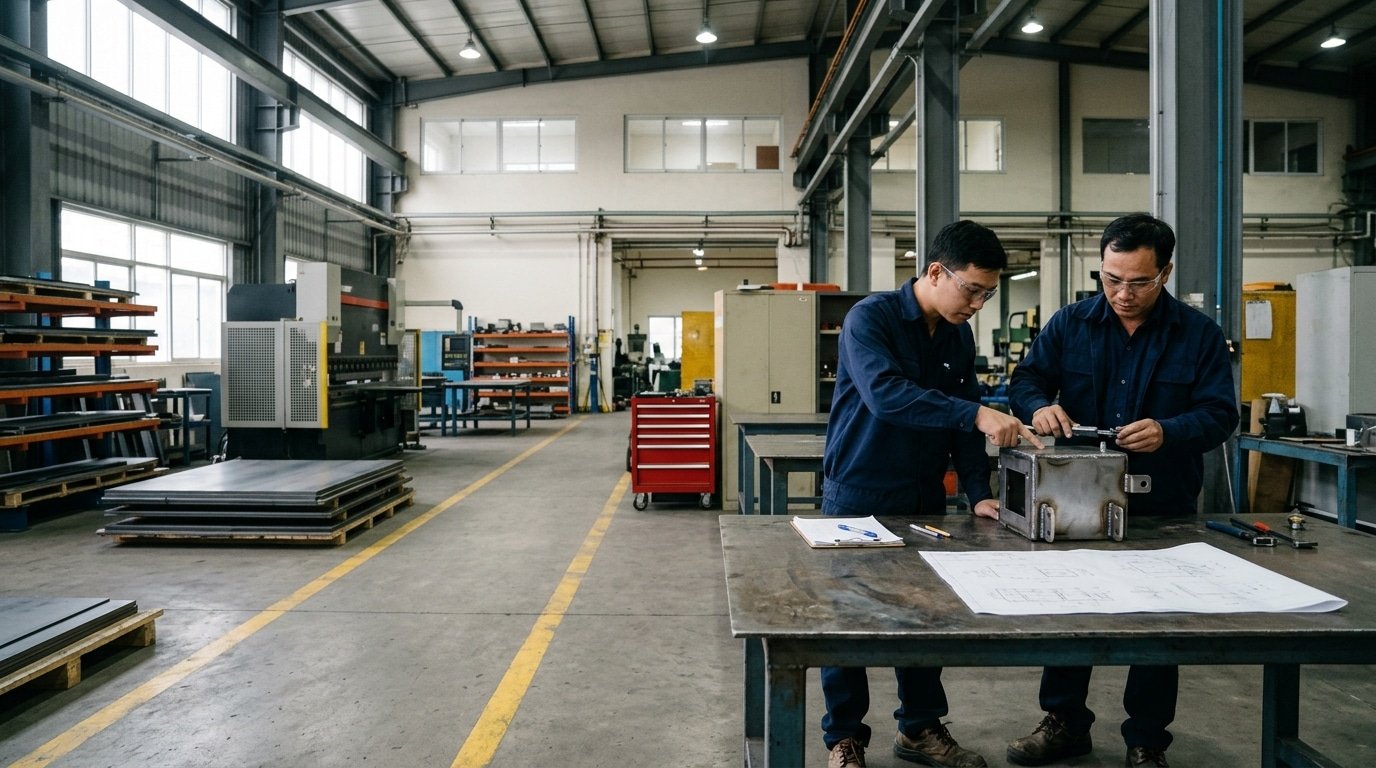
A small bracket may be straightforward to manufacture but sensitive to burr direction or distortion around a bend. A larger enclosure may fit its drawing before coating yet have problems at hinges, threaded features or mating surfaces afterward. Reviewing the complete route helps identify where inspection and protection are needed.
With welded frames, discuss fixture access, welding sequence, distortion control and any subsequent machining. Ask which drawing or contractual requirements govern weld acceptance. A photograph of a robot or a large welding bay does not answer whether the process is appropriate for the specified joint and material.
Machined and cast components
For machined components, match the part’s geometry to the proposed workholding, tooling and measurement approach. Equipment lists help start that conversation, but the buyer also needs to understand setups, datum control and how important features will be verified.
A cast housing adds another set of dependencies. Establish who owns and maintains the tooling, who supplies the casting, where machining occurs and how material and inspection records remain linked. If a casting defect is discovered after machining, the commercial relationship between the foundry and machine shop can affect the speed of investigation and replacement.
The following matrix translates common part descriptions into questions for the shortlist. It describes evidence to seek, not a nationwide capability guarantee.
| Part example | Production route to clarify | Evidence useful at the screening stage |
| Bent bracket | Cutting, deburring and forming | Material specification, bend approach and critical-feature inspection |
| Welded machine frame | Cutting, fixturing, welding and possible machining | Proposed sequence, acceptance requirements and dimensional checks |
| Machined housing | Material preparation, setups and machining | Workholding plan, measurement method and relevant production examples |
| Machined casting | Tooling, casting, treatment and machining | Named processors, material records and traceability between operations |
| Finished enclosure | Fabrication, coating, hardware and assembly | Finish requirements, masking plan and final fit checks |
Surface finishing and final assembly
Surface treatment deserves an early place in the supplier search. A well-made metal component still needs a finishing route compatible with its material, dimensions, appearance and intended environment. Confirm the specification, pretreatment, masking and handling requirements before treating coating as a routine final step.
For assemblies, identify who purchases standard hardware, controls substitutions and verifies the complete unit. Check the packaging concept alongside the production route, particularly when exposed surfaces, projecting features or loose accessories can be damaged during handling.
These are screening questions. Once the process appears suitable, the [supplier qualification checklist] provides a more detailed route for examining quality systems, manufacturing evidence and approval requirements.
Look below the first tier supplier
Local procurement and imported inputs
Local availability varies by material, specification and order size. A supplier may buy steel from a distributor in Vietnam while the original mill is elsewhere. A domestically purchased coating or hardware item may also depend on imported inputs.
JETRO’s FY2025 survey, published in English in 2026, reports 38.1% local procurement among manufacturing respondents in Vietnam (n=337; page 49). Fieldwork covered Japanese-affiliated companies in August–September 2025. The sample does not represent every Vietnamese factory. “Local” includes locally operating foreign-affiliated suppliers and is neither a customs-origin calculation nor a domestic-value-added measure.
The practical implication is to investigate the input chain for the proposed part. Record the approved source, normal purchasing quantity, replenishment assumptions and substitute approval process. A material available for a sample may require a different purchasing arrangement at production volume. Ask whether the sample uses normal production stock or a one-off purchase. For repeat orders, establish how material will be reserved, what happens when stock is depleted and who approves an alternative. These details can reveal an input constraint before it becomes a delivery issue.
Tooling coatings and specialist subcontractors
Ask for the names and locations of outside processors that can affect delivery or product acceptance. Heat treatment, plating, precision grinding and specialist testing deserve attention when they sit on the critical path.
A compact dependency record should identify the operation, business performing it, approval status, scheduling responsibility and proposed recovery option. It should also show how the drawing revision and lot identity travel with the parts.
Different supplier names do not always provide independent sources. Two fabricators may use the same coating line or material distributor. Discovering that relationship early helps procurement decide where an alternative is actually needed. It also prevents a nominal second source from being mistaken for a fully independent production route.
Check the operating conditions around the factory
Power transport and port access
The World Bank’s October 2026 Vietnam assessment highlights infrastructure constraints and exposure to imported energy. Buyers can translate that national context into practical questions about the site.
What happens to work in progress after an interruption? Which operations can continue on backup power? How is equipment restarted and checked? Answers should relate to the proposed process rather than a general statement that a generator is available.
For logistics, evaluate the journey from the last production operation to the receiving location. Identify factory loading arrangements, inland transport, port cutoffs, proposed ocean service and any transshipment. A port nearby may be useful, but the available sailing and handling plan determine its relevance to the order.
Capacity workforce and continuity planning
Capacity discussions should identify the limiting operation. A factory can have open floor space while its inspection team, finishing subcontractor or specialist machine is fully committed.
Ask how the quoted output was calculated: available shifts, working days, cycle assumptions, setup changes and other committed orders. Examine who can run the process and provide cover when a key person is absent. For a repeat program, discuss planned maintenance and the conditions that would trigger a schedule review.
This approach is consistent with NIST MEP’s supplier-selection guidance, which emphasizes understanding a supplier’s capabilities, quality information, scale and operating dependencies. The aim is to identify the evidence needed for a realistic production plan, then assign an owner to resolve each outstanding question.
What to watch when planning for 2027
Demand and investment signals
The outlook supports continued investigation of Vietnam, while allowing for different planning scenarios. Two institutional assessments available at this article’s update date illustrate the distinction between current information and expectations:
| Institution and release | 2026 GDP estimate or forecast | 2027 GDP forecast |
| World Bank, October 2026 Macro Poverty Outlook | 7.4% | 7.3% |
| ADB, September 2026 Asian Development Outlook | 7.8% | 7.6% |
Sources: World Bank and Asian Development Bank. These are separate institutional views, not completed annual results or forecasts for an individual metalworking supplier.
Use the outlook to frame questions about investment and demand. A new machine can expand a supplier’s options, but it becomes relevant to the buyer after installation, process development and validation. A planned road or industrial park should enter the sourcing case according to its operational status and direct relevance to the production route.
What should change your sourcing plan
Set review triggers around the dependencies already identified. This gives procurement a reason to revisit assumptions without rebuilding the shortlist after every economic headline.
| Watch item | Trigger to investigate | Buyer response |
| Material availability | Longer replenishment or a proposed grade change | Reconfirm approved sources and substitution controls |
| Production capacity | A new customer changes the proposed schedule | Review the limiting operation and delivery allocation |
| Outside processing | A processor changes location or equipment | Reassess the affected route and approval evidence |
| Transport | Service, port or routing changes | Recheck transit assumptions, packaging and inventory coverage |
| Import requirements | A relevant rule or classification changes | Review the specific product with the responsible trade specialist |
For the first project, choose a part family whose dependencies can be understood and tested. The guide to [choosing your first part family for Vietnam] explains how to turn that selection into a controlled production trial.
Frequently asked questions
The best location is the one that provides a suitable production route for the actual part. Compare relevant suppliers, outside processors, material access and shipping arrangements. Regional industrial activity can guide the search, but the shortlist should depend on demonstrated capability and the requirements of the order, including volume and delivery pattern.
Some inputs may be available from mills, producers or distributors in Vietnam; others may depend on imports or larger purchasing quantities. Confirm the exact grade, form, size and required documentation. Buying from a local distributor does not establish where the material was originally produced or whether an alternative source has been approved.
Export growth describes economic activity across many businesses and product categories. A specific sourcing decision still requires evidence about the proposed factory, process and product. Relevant records may include material documentation, inspection results and production examples. A strong national export performance cannot establish whether a particular supplier will meet a particular drawing.
That depends on the supplier and product. Outside processing can be a sensible arrangement when responsibilities and controls are clear. Ask which operations are subcontracted, who approves the processors and how revisions, lot identification and inspection requirements are communicated. A supplier’s ability to manage that network matters alongside its own equipment.
Clusters can provide access to relevant businesses and services, but proximity alone does not establish compatibility with your specification. Map the actual relationships behind the proposed route. For the broader sequence from market research to an approved supplier and first shipment, see the [Vietnam sourcing guide for U.S. buyers].
Identify the right supplier ecosystem
Start with one product or part family. Share the drawing revision, material specification, expected order pattern and any known process or finishing requirements with VNO. If some details remain open, identify them at the start so the discussion can focus on what must be resolved. The immediate objective is a useful shortlist: suitable production routes, the businesses required to complete them and the evidence needed for the next decision. That creates a more productive conversation about manufacturing options in Vietnam before either side commits to a final quotation or production schedule.
