

A factory can have modern machines, an attractive quotation and a valid quality certificate while still being the wrong supplier for your component. The qualification question is specific: can this production site demonstrate that it can make your parts, to the agreed requirements, at the required volume, with problems detected and controlled before shipment?
That question matters when sourcing from Vietnam because the work may involve several organizations: the company issuing the quotation, the factory making the part, a finishing subcontractor and the party managing export documentation. Each relationship needs to be understood before production approval.
A useful qualification review connects requirements to evidence and evidence to a decision. It identifies who will approve the supplier, what remains unresolved and which conditions must be met before an order is released. The [practical Vietnam sourcing guide] explains the wider buying journey; this article focuses on the evidence needed to approve one manufacturer for a defined scope of work.
Define supplier approval criteria before the audit
Start with the part and its consequences
Prepare the technical baseline before requesting a factory assessment. Include the drawing revision, material specification, critical dimensions, finish, functional requirements, packaging and expected quantities. Identify characteristics whose failure would affect safety, assembly, service life or downstream production.

Consider two hypothetical purchases: a sheet-metal cover and a welded equipment frame. Both need controlled manufacturing, but the consequences of a cosmetic defect and a structural failure differ. The inspection methods, technical review and approval authority should reflect those consequences. Requirements for safety-critical products must come from the responsible engineering authority and applicable specifications.
Use a requirements-to-evidence checklist. For each critical requirement, record the evidence requested, the person reviewing it and the acceptance condition. “Good welding quality” is too vague to assess. An identified governing specification, documented procedure and defined inspection acceptance criteria create a reviewable requirement.
Define the site volume and decision owner
Confirm the legal entity that will contract with you and the address where production will occur. Establish which processes are performed there and which leave the site. Regional industry knowledge helps shortlist suppliers, but [Vietnam’s manufacturing landscape] cannot establish the capability of a particular factory.
Name a buyer-side approval owner and involve engineering, quality and procurement where their decisions are needed. Agree the production rate, demand assumptions and capacity evidence expected. Ask about dependence on a single machine, specialist operator or outside processor, and how an interruption would be managed.
The result should be a bounded approval scope: identified parts or part families, site, processes, revisions and volume assumptions. Approval for one uncomplicated component should not silently become approval for every product the supplier offers.
Verify certificates without mistaking them for product approval
Match the certificate to the work
Check the certificate’s legal name, production address, certified activities, standard edition, validity and issuing body. For a multisite certificate, inspect the relevant site listing. A certificate covering sales or distribution does not, by itself, establish coverage of a separate manufacturing location.
Use a certificate verification service such as CertSearch and confirm unresolved details directly with the certification body. Save the verification date and result with the supplier record. If a search produces no match, investigate spelling, entity names, site coverage and issuer records before reaching a conclusion.
The certificate is evidence about the management system within its stated scope. Your drawing, product tests and agreed production controls still need separate evaluation. A complete certificate folder cannot replace an inspection report for the component being purchased.
Account for the ISO 9001 2026 transition
ISO 9001:2026 was published on 16 September 2026, as confirmed by ANSI’s publication announcement. Buyers preparing 2027 supplier approvals should therefore check which edition appears on the certificate and the supplier’s transition arrangements.
Publication of a new edition does not make every existing ISO 9001:2015 certificate immediately invalid. ISO’s transition guidance provides for a transition period and directs certified organizations to their certification bodies for applicable timing. Verify the individual certificate’s status rather than judging it from the year alone.
Apply industry requirements where they belong
Automotive, aerospace and other customer programs may impose additional system, process or approval requirements. Identify these during the quotation stage and confirm the exact scope and edition expected. Do not add IATF 16949, AS9100 or a customer-specific approval package to every industrial purchase simply because the terminology sounds reassuring. Equally, do not waive a requirement that your customer or contract actually imposes.
Verify the process route on the shop floor
Follow the intended manufacturing sequence
Ask the manufacturer to explain how your part would move from material receipt through cutting, forming, machining, welding, finishing, inspection and packing. Review the intended route, including intermediate handling and outside processing. A machine inventory is useful background; the route shows how those resources would produce your component.
For each operation, examine equipment suitability, fixtures, programming, operator instructions and relevant maintenance records. Where possible, review comparable production and discuss the differences from your application. A machining center may accommodate the part’s dimensions while the proposed workholding makes a critical feature difficult to control.
Capacity should be assessed at the constraining operation. Ask how the available hours, existing commitments, setup time, inspection effort and expected losses support the promised output. If the bottleneck depends on one operator or machine, establish the realistic recovery plan. Spare equipment is only useful if tooling, programs and qualified personnel can support the alternative route.
For example, a supplier may quote a monthly output based on machining time while every part must also pass through one inspection station. Ask the team to reconcile both operations with the same demand. Include changeovers, planned maintenance and the work already occupying that station. This discussion can expose a capacity constraint without requiring access to another customer’s confidential drawings or pricing. Evidence can be anonymized while preserving the relevant production dates, operating conditions and output. Where business continuity relies on moving work elsewhere, review whether that alternative would require customer approval before it could be used.
| Process | Evidence worth examining | Question the evidence should answer |
| Cutting and forming | Material identification, tooling, setup and dimensional records | Can the blank and formed geometry be controlled consistently? |
| Machining | Workholding, program revision and inspection method | Can the specified features be produced and verified? |
| Welding | Applicable procedure, personnel qualifications and inspection records | Does the demonstrated welding scope match this product? |
| Finishing | Process specification, preparation controls and acceptance records | Will the finish meet its functional and appearance requirements? |
| Packing | Protection method, part identification and handling trial | Will conforming parts remain identifiable and protected in transit? |
Examine welding and other special processes carefully
For applicable welded products, establish the governing code and contractual edition. The American Welding Society’s D1.1 overview describes requirements for structural steel welding, including procedure and welder qualification, fabrication, inspection and acceptance. It should not be treated as the default code for every welded component.
Review the procedure and the qualifications of the personnel performing it as separate evidence. Check whether they cover the relevant application. For finishing, heat treatment or other specified processing, determine what parameters are controlled, what records are retained and which tests establish acceptance. An attractive finished surface may reveal little about the underlying preparation or treatment.
Test measurement capability not just calibration status
Ask the quality team to demonstrate how a critical feature would be inspected. Review datum setup, instrument selection, measurement instructions and the way results are linked to the part or lot. Examine calibration status, but also whether the method is suitable for the tolerance and operating conditions.
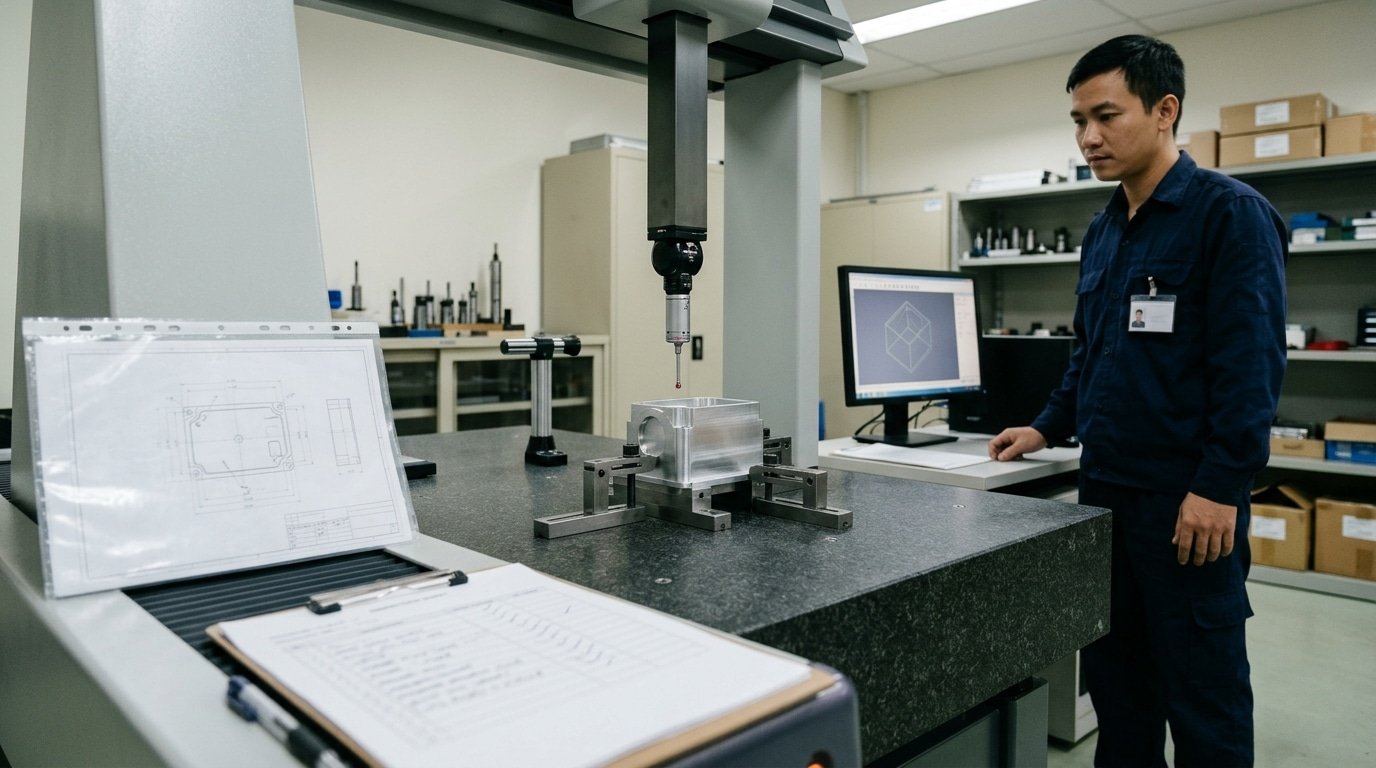
NIST’s metrological traceability guidance explains that traceability alone does not establish fitness for purpose; measurement uncertainty must also be suitable for the intended use. A calibration sticker therefore answers only part of the buyer’s question.
For repeatability or process-capability studies, agree the method, conditions and acceptance criteria with the responsible quality engineer. Avoid imposing one capability threshold on every characteristic or treating a few selected readings as proof of a stable production process.
Follow material and subcontracted work through the system
Trace a real lot from receipt to shipment
Choose a recent production lot and ask the supplier to reconstruct its history. Follow the incoming material record, material certificate where required, internal identification, production traveler, inspection results and finished-goods label. The records should connect to the physical material or parts being discussed.
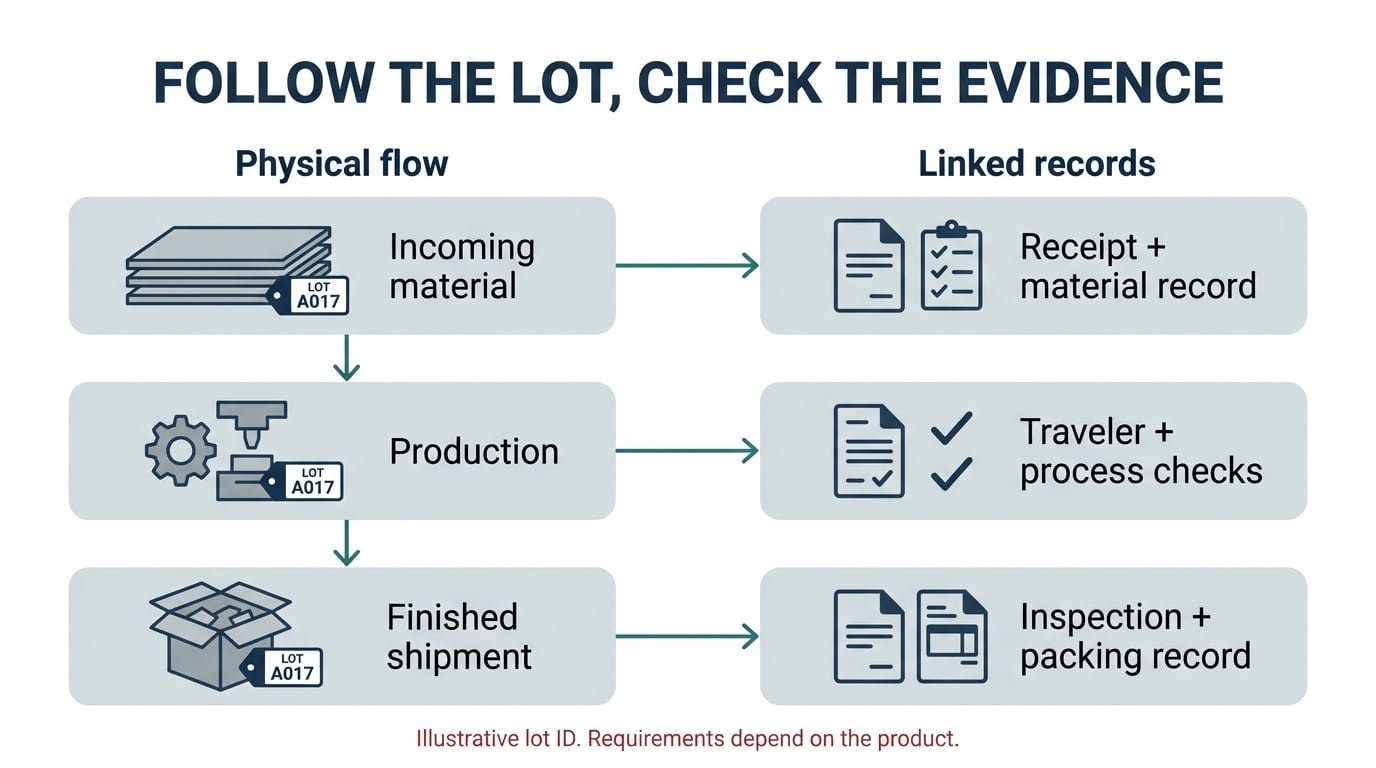
Suppose a machined housing requires a specified aluminum alloy. A certificate for an unrelated delivery does not establish the material used in the reviewed lot. The supplier should explain how incoming deliveries are separated, how identification survives cutting and machining, and how remnants or returned material are controlled.
Test the reverse direction as well: starting with a finished lot, can the factory identify relevant inputs and processing records? The required traceability depth will depend on the product and agreement. The objective is a usable chain of evidence, not a large collection of disconnected documents.
Make subcontracted processing visible
Outsourcing a process is not automatically a weakness. The important questions concern selection, approval, technical communication and control. Identify the actual processor and location, the requirements sent with the work and the evidence needed before it returns to production.
For a hypothetical powder-coated bracket, examine how part identity, coating specification, masking requirements and acceptance checks are communicated. Establish who can authorize a change of processor and whether the buyer must approve it. The contracting supplier should remain accountable for the delivered result under the agreed terms.
Review exceptions and changes
Ask to see how a rejected lot is contained, identified and prevented from accidental shipment. Examine a completed corrective action: what caused the problem, what changed, and what evidence showed the change worked? Confirm who can approve rework, repair or a deviation.
Drawing revisions, material substitutions, machine transfers and subcontractor changes need defined review routes. Review how a change reaches the people doing the work. Ask an operator or supervisor to locate the current instruction and explain how an obsolete version is removed. Then compare it with the revision shown on a recent inspection record. A controlled document on a manager’s computer is of limited value if the shop floor uses an earlier printout. For bilingual instructions, assign responsibility for resolving technical differences and confirm that operators understand the acceptance requirement. Agree who must receive a change notice and who can authorize implementation.
Quality traceability also differs from customs origin determination. The [Vietnam sourcing guide to tariffs, origin and traceability] explains the separate import questions that production records may help support.
Approve samples and the production process separately
Establish what a sample is intended to prove
A successful sample demonstrates conformity under the conditions used to make and inspect it. It does not automatically establish production capacity, consistency across shifts or control of outside processing. Ask whether the sample used the intended material, tooling, machine route and finishing source. Record any temporary arrangements.
Define the submission before work starts. Depending on the product, it may include identified samples, a drawing-linked dimensional report, material evidence, functional testing, finish results and a list of deviations. Resolve discrepancies against the agreed requirements rather than accepting an unexplained “pass” on a supplier form.
A limited order for tooling or sample development may be necessary before production approval. State its purpose and limits explicitly. Development authorization should not be mistaken for permission to manufacture unrestricted production quantities.
Choose the appropriate approval method
AIAG describes PPAP as a process for demonstrating that production consistently meets engineering requirements under production conditions. Use the submission requirements specified by the relevant customer or program. Full PPAP is not automatically required for every industrial component.
Similarly, IAQG’s 9102 guidance concerns a standardized first-article inspection process developed for aviation, space and defense, with potential use in other sectors. A buyer can require a documented first-article review without assuming that every purchase is subject to AS9102.
Define the trial and its release conditions
Agree the production trial’s purpose, quantity, duration and operating conditions before it runs. Select conditions that address the important uncertainties: setup repeatability, a production shift, tool changes, an outside process or the ability to maintain the planned rate. There is no universal trial size that proves every manufacturing process.
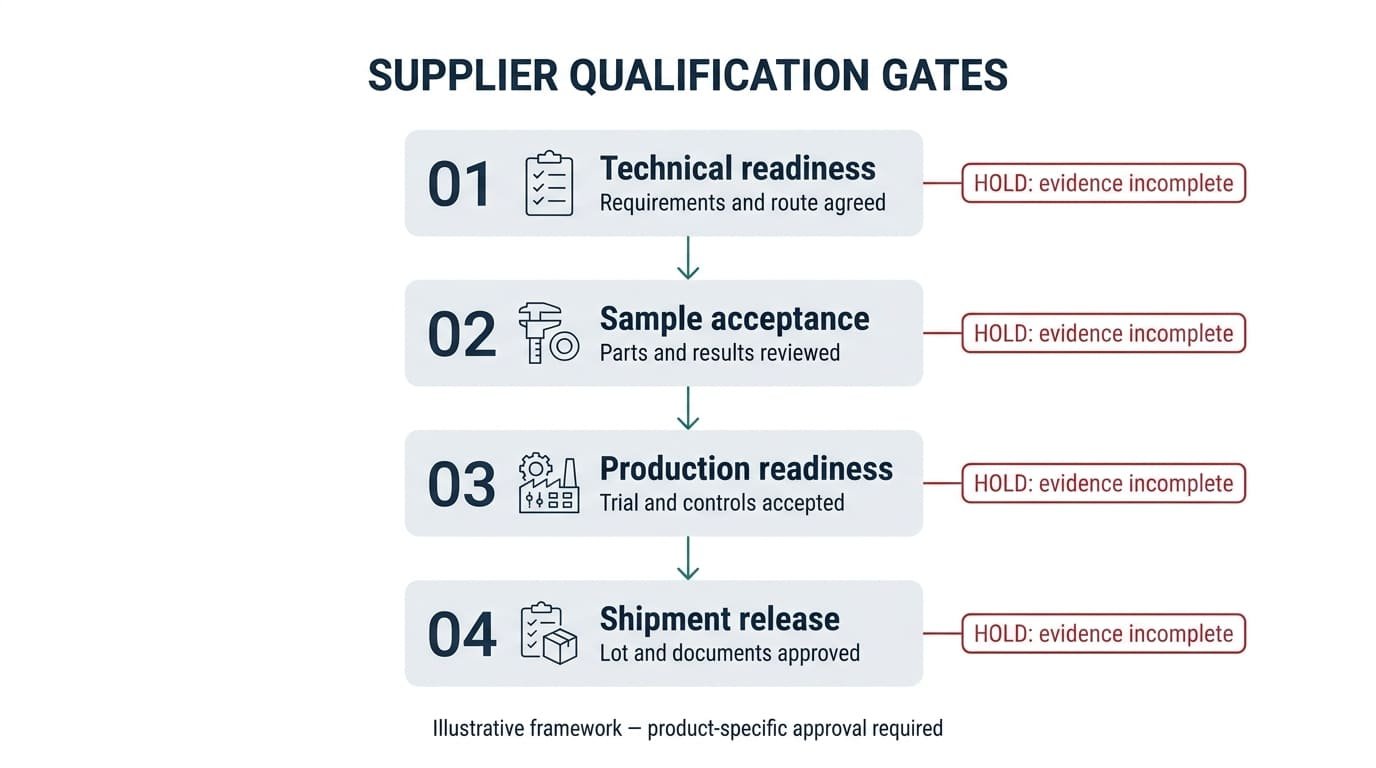
The following decision structure can be adapted to the product; it is a purchasing framework, not an additional certification standard.
| Approval gate | Evidence to review | Release condition |
| Technical readiness | Requirements, process route, feasibility concerns and agreed deviations | Responsible technical owners close the issues needed to proceed |
| Sample acceptance | Identified parts, inspection results and required tests | Samples meet agreed requirements or formally approved deviations |
| Production readiness | Representative trial records, process controls and capacity evidence | Buyer accepts the defined production scope and outstanding-risk treatment |
| Shipment release | Lot acceptance, identification, packing and required documents | Authorized release under the agreed purchase requirements |
If a trial reveals recurring defects, investigate and verify the corrective action before closing the relevant gate. Include the delivery condition in the approval evidence. A part that passes measurement before packing may arrive damaged, corroded or mixed with another revision. Review protection of functional surfaces, separation of similar parts and the link between package labels and inspection records. If the buyer’s receiving team needs a particular label or document format, test it during the trial shipment. This avoids approving a manufacturing process while leaving an unresolved handoff at the destination.
Keep sample acceptance distinct from approval to scale. The [first production transfer plan for Vietnam] explains how these decisions fit into the wider launch schedule.
Make and document the approval decision
Record the scope and outstanding actions
The final record should identify the supplier, production site, approved parts or families, drawing revisions, processes and conditions reviewed. Attach the evidence used and name the people authorizing the decision. This gives the next buyer or engineer a usable record when circumstances change.
Three statuses are practical: approved for the defined scope; conditionally approved with explicit restrictions; or not approved pending resolution. For a conditional decision, state the missing evidence, owner, deadline and permitted activity. A time-limited sample order is very different from conditional approval for recurring production.
Do not let an attractive aggregate audit score conceal a blocking issue. An unresolved safety requirement, unavailable mandatory process approval or inability to verify a critical characteristic needs its own decision. The responsible authority must decide what prevents release; procurement should not average it away against housekeeping or commercial strengths.
Check that the commercial agreement supports the technical decision. Inspection responsibilities, tooling ownership, authorized drawing access, change notifications and treatment of nonconforming goods should be understood. If extra inspection, inventory protection or rework changes the economics, revisit [the total cost of manufacturing in Vietnam] before committing to a volume assumption.
Keep qualification active after the first order
Initial approval establishes a starting position. Review early deliveries against agreed quality and delivery definitions, including recurring nonconformities, response times and unapproved changes. Decide which events trigger additional review: a new site, a critical process change, a different subcontractor or repeated failure of an agreed requirement.
Follow-up should be proportionate to the evidence and consequences. A supplier with reliable records and stable results may need a different review frequency from one still resolving a launch issue. The purpose is to maintain confidence in the approved scope as production develops.
Frequently asked questions
No. It is one input into the decision. Verify the certificate’s scope and status, then assess the proposed production route, product conformity, measurement methods and capacity. Supplier approval should relate to your actual parts and requirements, not only the existence of a quality-management certificate.
Sometimes a remote review can resolve defined questions efficiently, especially when records are available and the process is already understood. It may leave uncertainty about material segregation, actual routing, equipment use or operator practice. Decide the assessment method according to what needs verifying, then document any limitations and follow-up.
No. Confirm the requirements of your customer, sector and purchase agreement. Where PPAP is required, follow the agreed submission scope and approval process. For other purchases, define a proportionate sample and production-validation package rather than adopting an automotive checklist without considering its purpose.
Identify the processor, its location and the controls applied to it. Confirm who approves the source, how technical requirements flow down and how conformity is checked on return. Establish change-notification obligations and accountability before approving the production route. An undisclosed subcontractor creates a different risk from an approved, controlled specialist.
Use triggers tied to the approved scope: significant site or process changes, new critical product requirements, repeated quality failures, relevant certification changes or an extended interruption that affects readiness. Review the affected risks and evidence. Requalification need not always mean repeating every original audit activity.
Define the evidence for your first production order
Bring the current drawing, expected quantities, material and finish requirements, and the questions your team still needs answered to a qualification discussion with VNO. Start by defining the decision: which site, product scope and production conditions are under review, and who will approve them?
A focused evidence request makes that conversation useful. It allows supplier responses to be checked against the same requirements and gives engineering, quality and procurement a shared basis for deciding what can proceed, what needs further work and what must remain on hold.
