

A useful first production transfer answers a specific question: can a qualified supplier in Vietnam manufacture and deliver this part family under conditions the business can sustain? That is a better starting point than moving a percentage of purchasing spend simply because the next budget cycle has arrived.
After a manufacturing trade show, a buyer may have several promising contacts, new quotations and a mandate to develop another source. Turning that interest into a controlled project requires a product decision, an evidence plan and a continuity arrangement with the current supplier. The first project should be large enough to test the important manufacturing and delivery assumptions, while keeping the consequences of a delay manageable.
For 2027 planning, begin with a bounded part family and expand when the evidence supports expansion. The approach below is a practical project framework. Its approval thresholds should be set for the product, customer and production environment involved.
Set the baseline and the purpose of the move
Decide what success means
Cost, resilience and additional capacity can all justify a second source, but they produce different acceptance criteria. A cost project needs a credible comparison after tooling, qualification, logistics and working capital. A capacity project needs evidence that the proposed route can support the required demand. A continuity project needs to reduce the particular disruption the business is trying to manage.
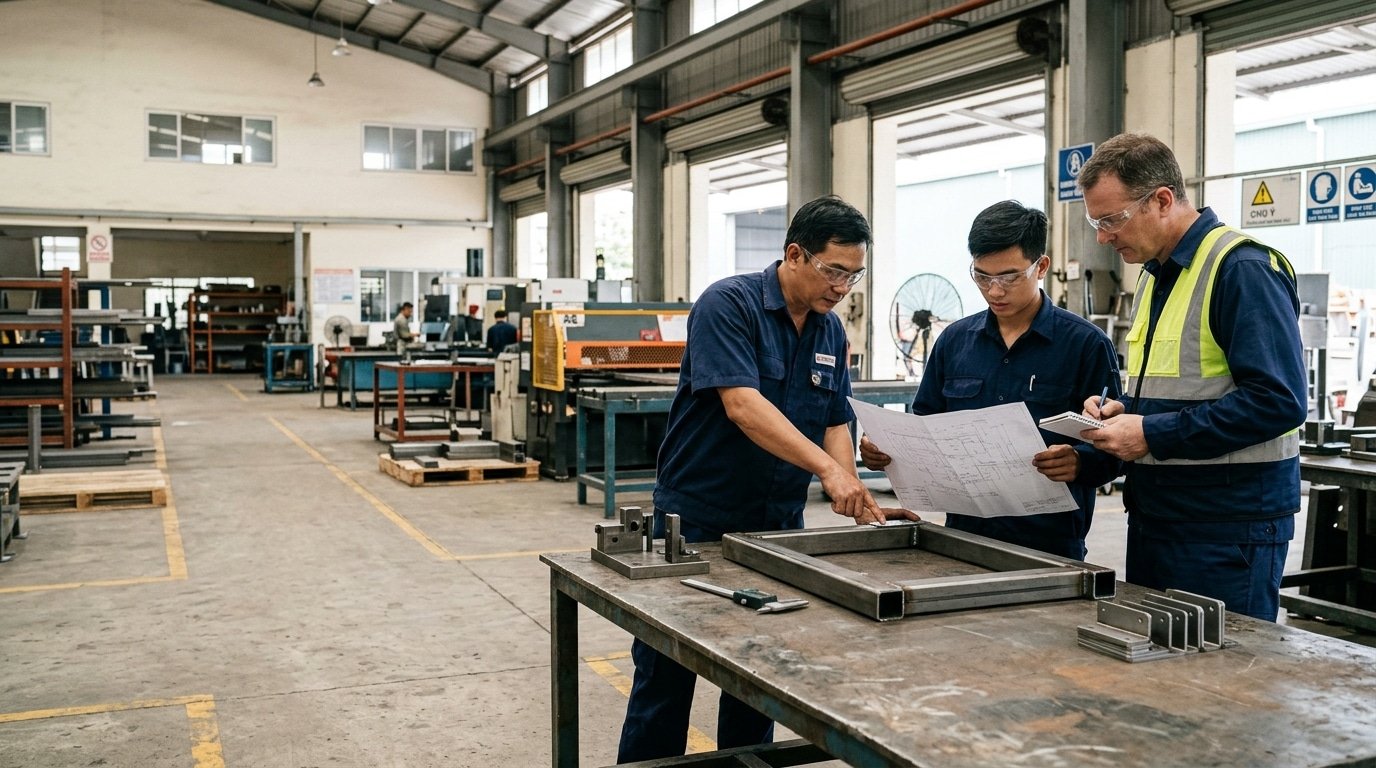
Write a short project charter identifying the part family, the business objective, the decision owner and the conditions that would stop the project. Include the target receiving location and the intended production period. “Develop another source” is too vague to resolve a disagreement later about whether a more expensive but operationally independent supplier meets the brief.
If the country decision remains open, use [Vietnam vs. China manufacturing] to establish the sourcing strategy before committing engineering resources to a transfer. The broader [Vietnam manufacturing sourcing guide] connects that decision with supplier capability, qualification and import planning.
Measure the current source fairly
Record the incumbent’s actual delivered cost, accepted quantities, delivery performance, order flexibility and known constraints over a relevant period. Separate recurring performance from an exceptional disruption. Include the support your team provides, such as drawing clarification, inspection or emergency scheduling, because the new source may need comparable support.
Then document the assumptions behind the proposed alternative. Demand, exchange rates, freight and import costs can change between quotation and release. Use the same commercial basis for both sources and test the result against [the true cost of manufacturing in Vietnam]. A transfer budget should also identify who pays for duplicate tooling, additional inventory and unsuccessful trials.
Rank candidate parts by transfer readiness
Start with requirements that cannot be traded away
Annual spend is a useful business measure, but it does not show whether a part is ready to move. First identify constraints that must be resolved before a pilot can proceed: rights to use the drawing, required customer approval, applicable product requirements, safety consequences and access to necessary tooling or processes.
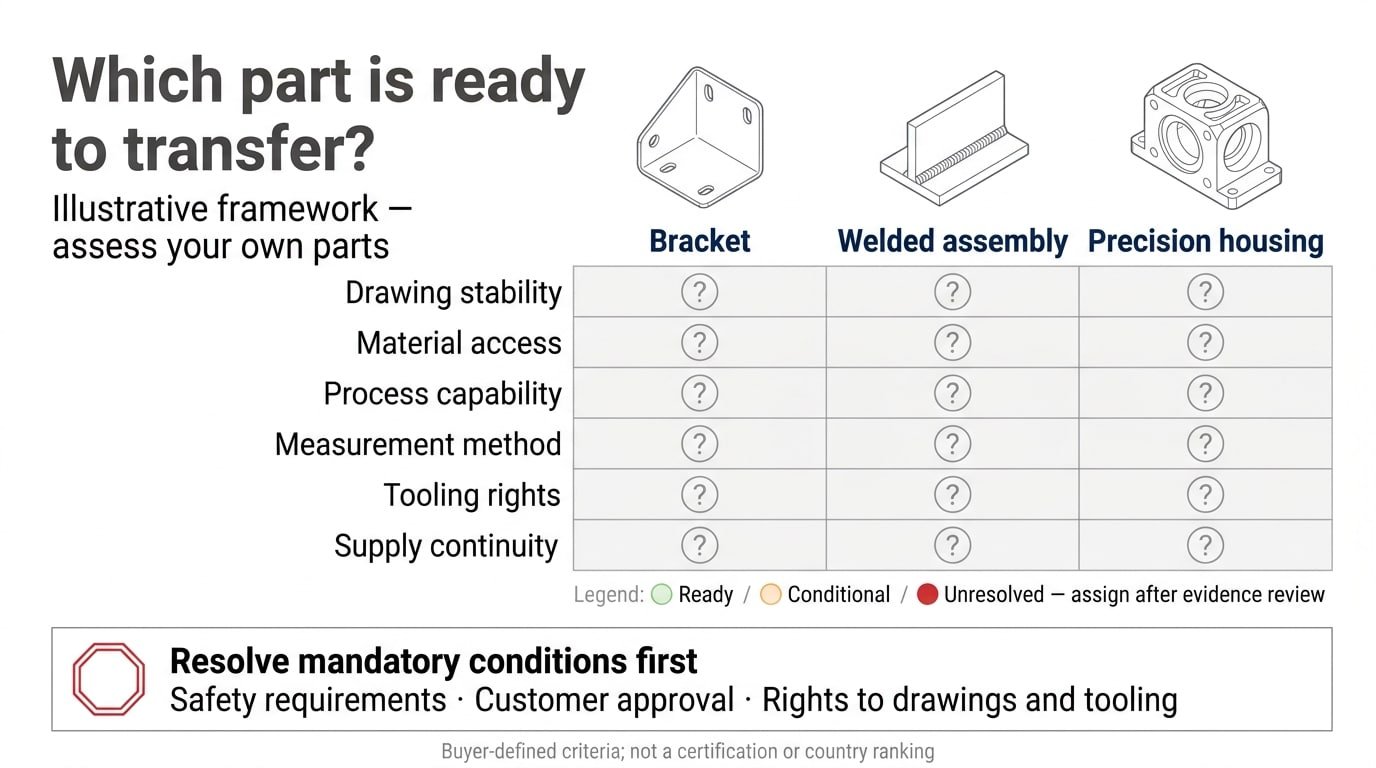
A strong score elsewhere should not override one of these conditions. For example, attractive pricing cannot compensate for an unresolved right to reproduce a proprietary fixture. A component whose failure could create a serious safety issue needs an approval plan appropriate to that consequence, regardless of its simple appearance.
Compare readiness using the same questions
Evaluate each candidate against drawing stability, material availability, process capability, measurement needs, tooling dependence, demand visibility and the effect of a supply interruption. Use a small shared vocabulary such as ready, conditional and unresolved. Record the evidence beside each rating so the scorecard does not become a collection of impressions.
| Readiness factor | Evidence to request | Condition to resolve before commitment |
| Product definition | Released drawing, specification and revision history | Conflicting requirements or pending redesign |
| Manufacturing route | Proposed operations, equipment and outside processes | An unproven critical operation |
| Material supply | Grade, source, availability and permitted alternatives | An assumed substitution without engineering approval |
| Tooling and inspection | Ownership records, fixture plan and measurement method | Missing access or an unsuitable inspection method |
| Business continuity | Demand plan, overlap options and recovery route | A transfer that would immediately exhaust supply cover |
If a numerical score is helpful, the buyer should set weights that reflect the project objective. Preserve the underlying evidence and unresolved conditions; a total score alone is not an approval. Revisit the assessment when a drawing, material source or production route changes.
Follow dependencies beyond the first factory
Ask where raw material, purchased components, tooling and outsourced finishing will come from. A supplier in a different country may still depend on the same upstream producer as the incumbent. That may be acceptable, but the project should accurately describe which risk it reduces.
NIST MEP’s supply-chain guidance identifies mapping, risk assessment, alternative suppliers and safety stock as tools for managing disruption. Apply that logic to the actual bill of materials. For example, an alternate fabrication site will not resolve a shortage of a proprietary casting if both sites require that casting from the same source. Use [Vietnam’s manufacturing landscape] to frame the process and ecosystem questions, then verify availability with the proposed supplier.
Choose a pilot that can answer the important questions
The easiest part to manufacture is not automatically the most useful pilot. If the intended program depends on welding, coating and dimensional control after welding, a laser-cut blank alone will provide limited evidence. The pilot should include the processes that determine whether the wider family can succeed.
Consider three illustrative candidates. These are planning examples, not VNO customer results or claims about a country’s capability.
A formed bracket might test material substitution controls, bend consistency, hole location and protective packaging. It could be a useful starting point when the drawing is stable and the manufacturing route is well understood. However, an undocumented surface requirement or unclear mating interface can make even this apparently simple part difficult to approve.
A welded assembly might reveal whether the supplier can maintain geometry through welding and finishing. Its pilot should examine the proposed fixtures, assembly sequence, inspection points and correction methods. A hand-adjusted sample that fits once may not answer whether the intended production route will repeatedly achieve the required result.
A precision housing might test datum interpretation, machining sequence, measurement access and cleanliness. Choosing it first can be reasonable when those are central to the future program and the buyer has the resources to review the evidence. It is less suitable when the project team cannot yet define the functional requirements or approve the measurement approach.
For the selected family, write down the questions the pilot must answer, the evidence required and the person authorized to accept it. Specify which variants are represented and which remain outside approval. A successful trial on one size or material should not automatically authorize every related part number.
The pilot also needs a usable outcome if it fails. Decide whether the next action would be a corrected trial, a different supplier, a narrower scope or a pause. That prevents sunk tooling costs from becoming the reason to approve an unresolved process.
Prepare the technical and commercial transfer pack
Establish one controlled technical baseline
Provide a released drawing and bill of materials, applicable specifications, revision identifiers and clearly identified critical characteristics. Include material requirements, finishing, marking, cleanliness, packaging and the intended assembly interfaces where relevant. Identify which document governs when a model and drawing differ.
Separate mandatory requirements from preferences and open questions. Suppliers should list exceptions explicitly; silence should not be treated as evidence that every requirement is understood. Maintain a clarification log with the question, agreed answer, approving person and affected revision. If an accepted clarification changes the requirement, update the controlled package before production.
Provide inspection expectations early enough to affect the manufacturing plan. A measurement requirement discovered after fixtures have been built can force an avoidable redesign. Where customer-specific approval documents are required, identify the submission level, format and approver before the sample order.
Confirm rights and responsibilities
Do not assume payment for a tool automatically establishes every right needed to relocate, duplicate or modify it. Review the relevant agreements and obtain clarity on ownership, access, maintenance, storage, transfer and disposal. The same review should cover drawings, software, programs and supplier-developed process information.
For a relocated tool, record condition and maintenance history before dispatch and define acceptance after installation. For a duplicate tool, budget separately for design, manufacture, validation and ongoing upkeep. A duplicate may preserve continuity, but it still needs qualification on the receiving site’s equipment and process route.
Make the commercial response comparable
State forecast demand, order patterns, delivery destination and the requested quotation basis. Ask suppliers to distinguish recurring price from tooling, development, testing and other one-time charges. The detailed comparison belongs in [the true cost of manufacturing in Vietnam]; the transfer pack should give every participant the same inputs.
Assign owners for material approval, engineering changes, quality release, purchasing, freight and import review. If several companies participate, identify who can authorize each decision. Meeting attendance is not the same as approval authority.
Run the project through approval gates
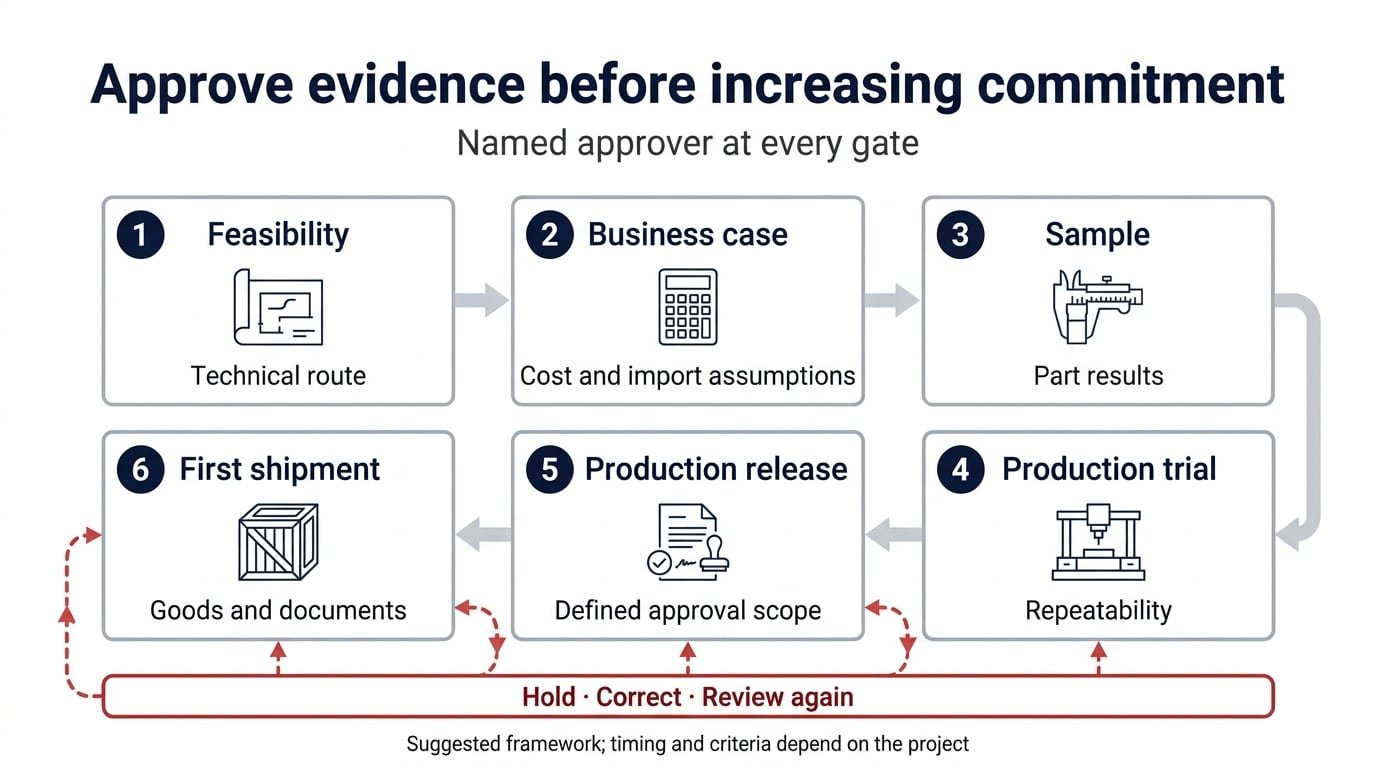
An approval gate is a recorded decision supported by evidence. It should identify what has been accepted, what remains restricted and what must happen next. The sequence below is a suggested project structure; it is not a universal standard or a promise that every project will finish within a fixed number of weeks.
Confirm feasibility and the business case
Begin with a supplier review of the controlled package and proposed production route. Close material, tolerance, tooling and outside-process questions before treating the quotation as a production commitment. Engineering should approve technical exceptions, while purchasing verifies commercial assumptions and capacity commitments.
Review classification, origin evidence and applicable import requirements while the route is still being designed. Avoid building the business case around an assumed tariff treatment that nobody has checked. [U.S. tariffs, origin and traceability for Vietnam sourcing] explains the separate questions that require attention before an order and before entry.
Approve samples and a representative production trial
Samples should be identified by part number, revision, material and the process used. Compare the inspection results with the agreed requirements, investigate deviations and record the disposition. If an exception is accepted for a limited trial, specify its quantity or duration and prevent it from silently becoming the production requirement.
The subsequent trial should use the intended manufacturing route, people, equipment, tooling and outside services sufficiently to test the claims being made. Define the trial size and operating conditions from the product risk and evidence needed. Review defects, rework, interruptions and cycle assumptions, including problems corrected before shipment.
Formal approval systems apply when the customer or sector requires them. AIAG’s Quality Core Tools distinguish production approval from simply obtaining an acceptable sample; its PPAP guidance addresses consistent conformance during an actual run at production rates. IAQG’s 9102 guidance concerns standardized first-article documentation, primarily for aviation, space and defense. Neither should be presented as a blanket requirement for every industrial purchase.
Separate production release from shipping readiness
Use [how to qualify a Vietnamese manufacturer] for the deeper supplier-evidence assessment. In the transfer plan, record the specific site, route, part revisions and conditions covered by approval. A release should also identify outstanding actions and any restrictions on volume or variants.
Before the first shipment, check packaging, identification, quantities and the agreed inspection records. Reconcile commercial and shipping documents with the actual goods and approved route. Include receiving arrangements and a contact for immediate escalation. Parts that pass dimensional inspection can still arrive unusable if protection, handling or documentation fails.
| Gate | Required decision | Lead buyer owner | Example hold condition |
| Feasibility | Approve the technical route and close exceptions | Engineering | Unresolved critical requirement |
| Business case | Accept cost, capacity and import assumptions | Purchasing with trade support | Material cost or import treatment remains unverified |
| Sample | Accept documented part results | Quality and engineering | Unapproved deviation |
| Production trial | Accept repeatability on the intended route | Quality and operations | Recurring defect without an effective corrective action |
| Production release | Authorize the defined scope | Authorized program owner | Approval evidence does not cover the intended variant |
| First shipment | Confirm goods and documents are ready | Logistics with quality | Packaging or traceability records do not match the goods |
Schedule these gates around confirmed dependencies: material availability, tooling, outside processing, testing, review capacity and transport. Make waiting time visible. A supplier cannot recover a week spent awaiting an engineering decision merely because a target ship date remains on the calendar.
Scale without losing control of the existing supply
Plan overlap and recovery before release
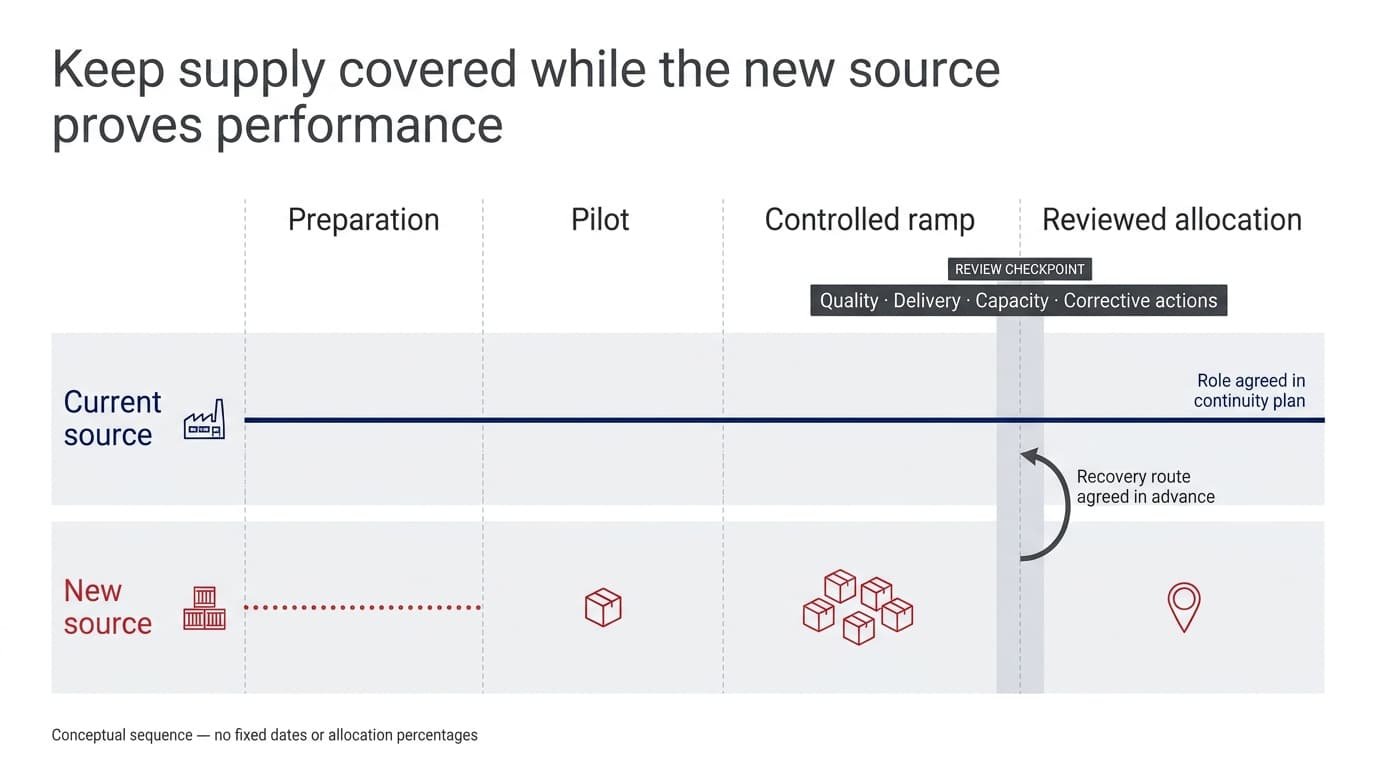
Maintain the existing source until the new arrangement has demonstrated the required performance and the buyer has approved the change in allocation. Agree the overlap openly, including minimum orders, tooling access and any capacity reservations. A supplier cannot necessarily restore a discontinued production slot immediately.
Size buffer inventory against demand, replenishment uncertainty and the time needed to respond to a problem. Consider shelf life, engineering-change exposure, storage and cash requirements. More inventory can protect service, but inventory that becomes obsolete after a revision is another transfer cost.
Define a recovery route for a rejected lot, delayed shipment or unavailable outside processor. State who can authorize containment, replacement production or expedited transport, and which decisions require engineering approval. Record the trigger before a shortage creates pressure to improvise.
Measure the early production that matters
Use a short dashboard tied to the project objective. Track accepted output, defects and rework, delivery against agreed dates, open corrective actions, engineering changes and the limiting operation’s demonstrated capacity. Give each measure a definition and data owner.
For delivery, clarify whether the promise concerns dispatch, port departure or arrival at the receiving site. For quality, distinguish pieces produced, inspected, rejected and accepted after rework. Otherwise a favorable headline can conceal an unstable process or an increasing inspection burden.
Review evidence across relevant production conditions before increasing allocation. A process change, material substitution, new subcontractor or different manufacturing site may require reassessment even when previous lots were acceptable. Agree notification and approval requirements in advance.
Expansion should follow a documented decision that the original questions have been answered and the next volume level is supported. If the new supplier still relies on frequent emergency intervention, the next task is to resolve that dependence. Increasing the order quantity will not resolve it by itself.
Frequently asked questions
Choose a part family with a clear business purpose, stable requirements, a feasible manufacturing route and manageable interruption consequences. The strongest candidate provides useful evidence for the wider program. It may differ from the cheapest part or the item with the highest annual spend.
Build the schedule from verified dependencies and the evidence required for approval. Material, tooling, tests, outside processes, customer review and transport can each set the pace. Use decision dates and named owners; a generic transfer timeline cannot substitute for those inputs.
Keep the incumbent’s role aligned with the continuity plan while the new source is being validated. Reduce allocation only after approval and a realistic recovery review. Consider contractual commitments and the practical time required to restore capacity if the new source encounters a problem.
Possibly, provided rights, condition, compatibility, transport and requalification are resolved. Compare relocation with duplication, including downtime and the effect on current supply. Tools that fit physically still require validation within the receiving factory’s actual process.
Conforming samples are one input. Scaling also needs demonstrated production performance, sufficient capacity, effective corrective actions, agreed change control and a functioning delivery process. The authorized buyer team should accept that evidence against criteria defined before the trial.
Choose the first part family to assess
Start with three to five candidate part numbers, current drawing revisions, expected volumes and the reason for adding a Vietnam source. Include known tooling constraints and the date by which a sourcing decision is needed. These inputs make an initial discussion more useful than an unqualified request for a lower price.
VNO’s New Product Introduction Support covers manufacturing introductions and production transfers to Vietnam, including engineering engagement, supplier coordination and quality support. Discuss a defined pilot scope, the evidence required and the responsibilities on both sides before committing to the production transition.
