

Policy sources reviewed October 23, 2026. Confirm the rules applicable to the actual product and entry date before shipment.
A promising conversation at FABTECH can move quickly from a sample part to a quotation. Before that quotation becomes a purchase order, the import team needs a more complete picture: what the product is, where its materials came from, what manufacturing took place in Vietnam, and which U.S. requirements apply when it enters the country.
Those are separate questions. A Vietnamese export address identifies where a shipment leaves. It does not, by itself, establish the finished product’s country of origin, the origin of its steel or aluminum, or its duty treatment.
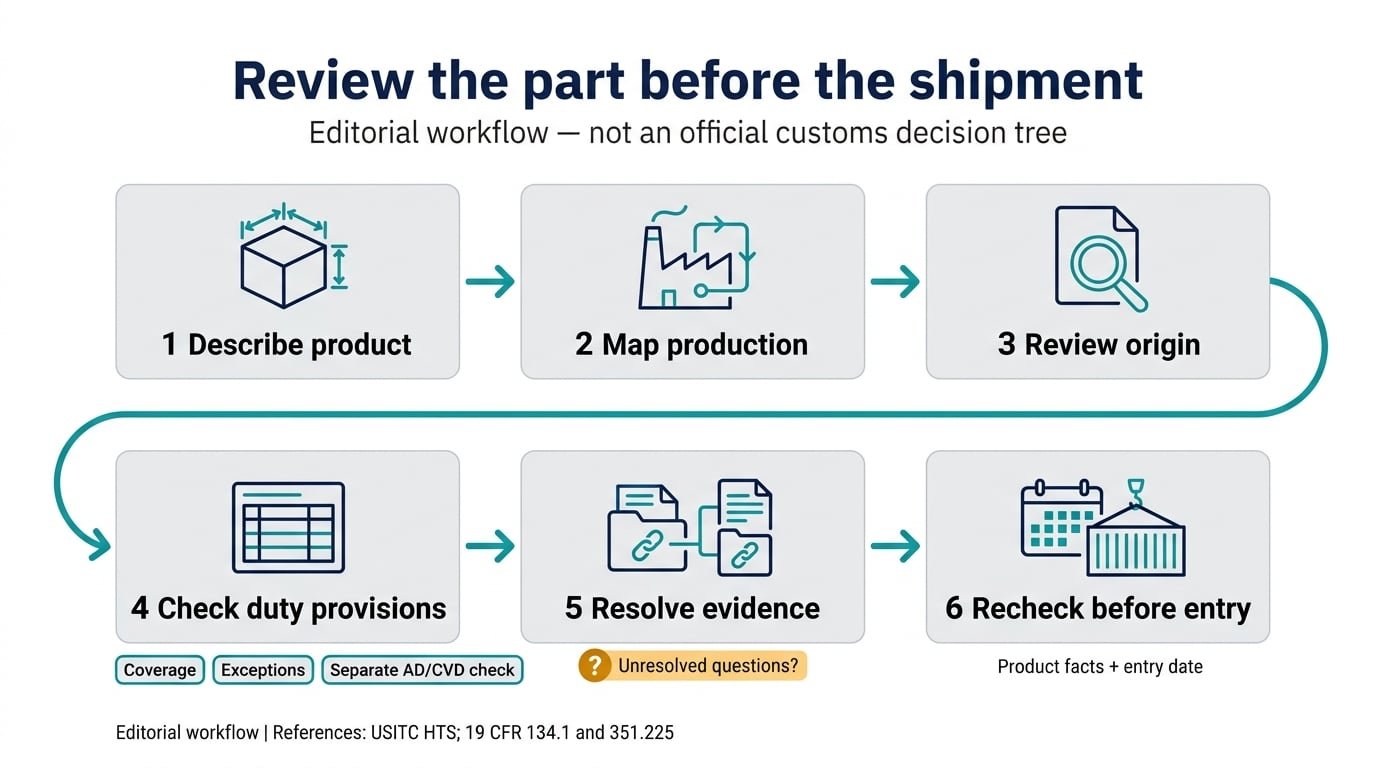
The practical approach is to build one evidence file around each part family. Connect the engineering description, production route, origin analysis, tariff review and shipment records. Then give procurement a documented duty input for its cost comparison. This article explains that process; the broader [guide to manufacturing in Vietnam] connects it with supplier selection, commercial evaluation and production planning.
What changed in 2026 and what needs checking now
Trade information should carry both a publication date and an effective date. A notice issued in June may govern entries beginning later that month. An October system update may implement a specific change without replacing the entire tariff framework. Keeping those distinctions visible prevents an old quotation from becoming an unintended policy assumption.

A dated policy snapshot
Three developments illustrate why an industrial buyer needs a product-level review:
- July Section 301 guidance. In its July 23, 2026 bulletin, CBP listed heading 9903.05.84 for products of Vietnam with an additional 12.5% duty, expressly subject to exceptions under headings 9903.05.85–9903.05.92. The CBP guidance includes an exception covering specified metal articles through heading 9903.05.90 and the relevant legal note. The USTR notice published July 28 identifies July 24 as the general effective date, with a limited transition provision.
- Changes to metal-product treatment. CBP’s June 5 guidance implemented changes effective June 8 to specified steel, aluminum and copper classifications and derivative products. It addresses coverage, Chapter 99 provisions and conditions for particular treatment. An older assumption that duty always applies only to metal-content value is unsafe: this framework addresses full customs value for covered products.
- Further October updates. CBP’s October 14 bulletin reports Section 232 updates in Harmonized System Update 2626, created October 9. It confirms the need to refresh the review; it is not a complete rate table for every industrial component.
The July percentage is therefore neither a universal total tariff nor a number to add automatically to every metal-product duty. For a 2027 sourcing program, use the rules verified for the expected entry date and identify what must be checked again. Announced negotiations or an open investigation belong on a watch list until an applicable measure is established.
Start with the product and the entry facts
The import review begins with the article as it will arrive in the United States. “Machined part,” “steel assembly” and “spare component” are rarely enough to support a careful classification review. The team needs a description that explains function, material, construction and condition at importation.
For example, a bracket sold separately and a complete electromechanical assembly containing a bracket present different classification questions. A photograph may show their shape, while the drawing and description explain what each does. Packaging several items together may also require a closer look at exactly what is being entered.
Create a classification fact sheet with the part number and drawing revision, material specifications, component breakdown, intended use, relevant dimensions and photographs. Include whether the article is complete, unfinished, assembled or supplied separately. Ask engineering to resolve technical ambiguities before asking the broker to evaluate the tariff treatment.
The USITC Harmonized Tariff Schedule is the official lookup destination. Record the proposed classification, applicable notes, additional Chapter 99 provisions and the review date. A supplier’s suggested code is useful input, but the U.S. analysis needs the actual product facts and U.S. tariff structure.
Give the file a clear revision history. If engineering changes the component’s function, replaces a material or combines previously separate parts into an assembly, send the revised description for review. A purchasing system may retain the same internal item number while the imported article changes. The classification file should make that change visible and identify which earlier assumptions need to be reconsidered before the next order.
Separate customs value from the purchasing spreadsheet
Add the seller, buyer, importer, transaction terms, expected entry date and valuation information to the file. Identify buyer-provided tooling or components, related-party relationships and separately billed charges for review.
Under the transaction-value rules in 19 CFR 152.103, assists can affect customs value. A tooling payment outside the unit-price invoice should therefore be visible to the person reviewing valuation. Customs value and total landed cost answer different questions; use the [Vietnam manufacturing cost and landed-cost guide] to translate the confirmed import assumptions into a business comparison without counting the same commercial expense twice.
Review duty provisions without assuming they all stack
A useful duty worksheet explains why each provision applies, does not apply or remains unresolved. It should make the reasoning reviewable instead of presenting a single unexplained percentage.
| Review item | Question to resolve | Evidence to retain |
| Ordinary tariff treatment | What classification and duty treatment fit this article? | Product description, tariff notes and classification rationale |
| Additional measures | Which country- or product-specific provisions apply? | Legal provision, effective date and relevant Chapter 99 heading |
| Exceptions | Does the product meet the exact exception conditions? | Applicable note and supporting product or supply-chain facts |
| Metal-product rules | Is the article covered, and which value or sourcing conditions matter? | Composition, coverage review and required metal records |
| AD/CVD | Is the merchandise within an order or relevant determination? | Scope text, production facts and specialist assessment |
Treat this as a working review format, not a prescribed government form. Give every unresolved row an owner and a due date. An empty field should remain visibly open until the supporting information arrives.
Distinguish “reviewed and outside scope” from “not yet reviewed.” They can look identical in a spreadsheet if both produce a blank duty cell, yet they represent very different levels of confidence. Attach the basis for an exclusion to the row that uses it. If the cost model depends on that exclusion, flag the dependency so procurement can see the commercial consequence of an unresolved document or product detail.
Follow the exact metal provisions
“Contains steel” is a starting observation, not a complete Section 232 determination. Coverage can depend on the classification, legal description, composition and provision being claimed. The June guidance also distinguishes certain treatment by metal sourcing conditions. Those conditions should be checked in their own context; they do not establish a general percentage test for Vietnamese origin.
The July Section 301 exception is another reason to read across the provisions. The worksheet must show whether the particular metal article fits the exception and what duties remain applicable. Adding a country headline to a metal headline can produce a confident-looking but unsupported landed-cost estimate.
Check AD and CVD separately
Antidumping and countervailing duties require their own review. The written scope of the relevant order matters, together with the product’s characteristics and production history. A tariff-code search can help identify questions, but it cannot settle every scope issue.
Under 19 CFR 351.225, Commerce may make its own country-of-origin determination for scope purposes and is not bound by CBP marking or classification rulings. Circumvention inquiries follow a separate framework. A conclusion about finished-good marking should therefore never be treated as automatic clearance from all trade-remedy exposure.
Determine origin from the manufacturing facts
For the marking regime addressed in 19 CFR 134.1(b), further work in another country must substantially transform an article for that country to become its origin. Applying the rule requires the actual manufacturing facts and the correct legal framework.
A factory’s ownership, the country issuing its invoice and the source of its materials are useful facts, but none should be used as a substitute for that analysis. Chinese ownership does not by itself make every product Chinese-origin. Vietnamese incorporation does not by itself make every product Vietnamese-origin. Nor does this marking definition provide a universal “40% local content” shortcut.
Describe what changes during production
Ask the supplier to explain the condition of each important input when it arrives and the operations performed before shipment. Identify where cutting, forming, machining, welding, heat treatment, coating, assembly and testing occur. Record outside processors rather than compressing all operations into “made at our factory.”
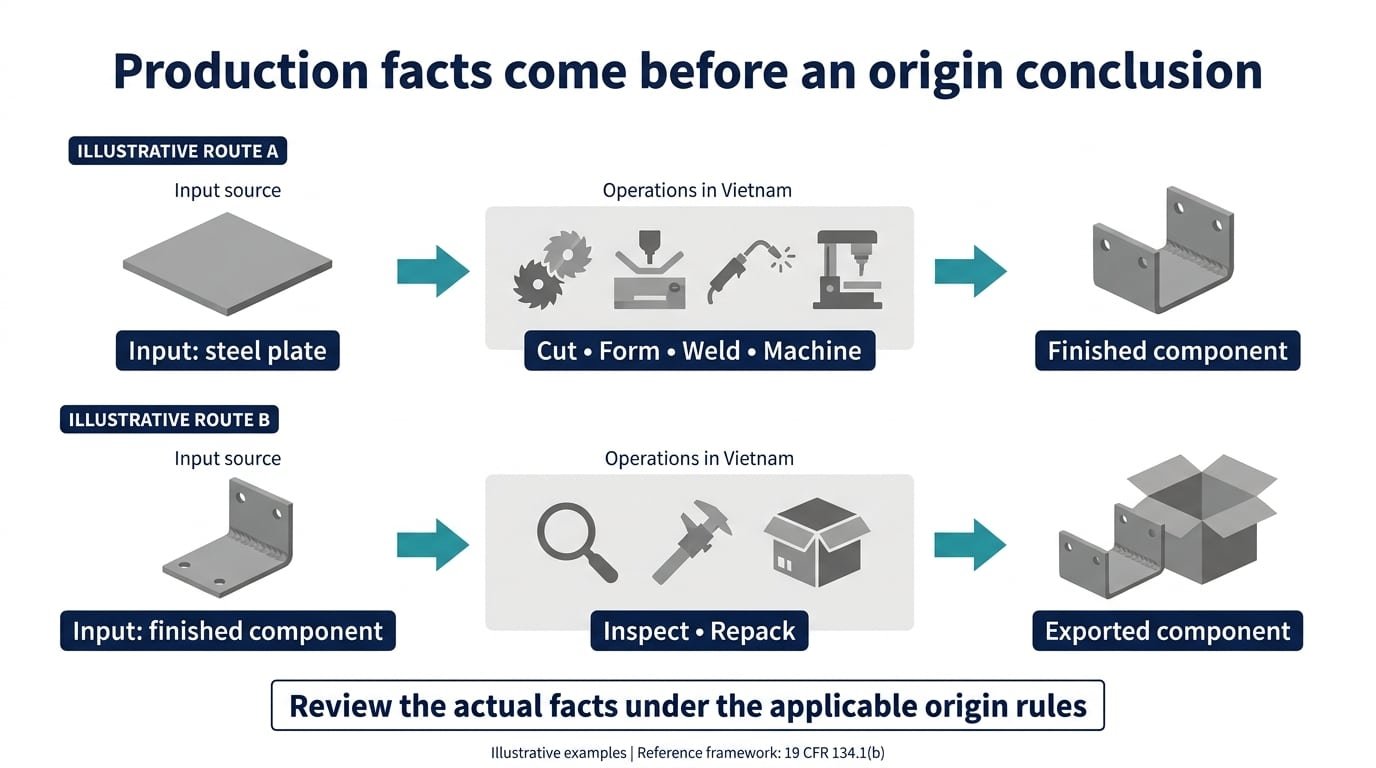
Consider two illustrative files. One covers imported steel plate that is cut, formed, welded and machined into a particular fabricated component. The other covers a finished component that arrives in Vietnam for inspection, repacking and export. The reviewer needs different evidence for these two production histories. This contrast does not assign an origin outcome; it shows why a shared export address cannot answer the question.
The description should also distinguish operations from commercial arrangements. A Vietnamese seller can coordinate work performed at several locations. The origin review needs the locations and processing facts, including relevant upstream work, rather than only the seller’s business registration.
Use rulings when the uncertainty matters
If uncertainty about classification or origin could change the sourcing decision, discuss a prospective ruling request with the importer and its customs adviser before committing to the production route. 19 CFR 177.2 calls for a complete statement of relevant facts. A ruling cannot compensate for an incomplete process description.
A similar published ruling may help frame the questions, but it should not be copied as a result for a different part. 19 CFR 177.9 ties application of rulings to the described facts and conditions. Keep the reviewed configuration under change control.
Build the traceability file before production starts
Traceability is most useful when records connect to the goods that actually ship. A material certificate stored somewhere in a supplier’s quality system does little for an importer if nobody can connect it to the relevant production batch.
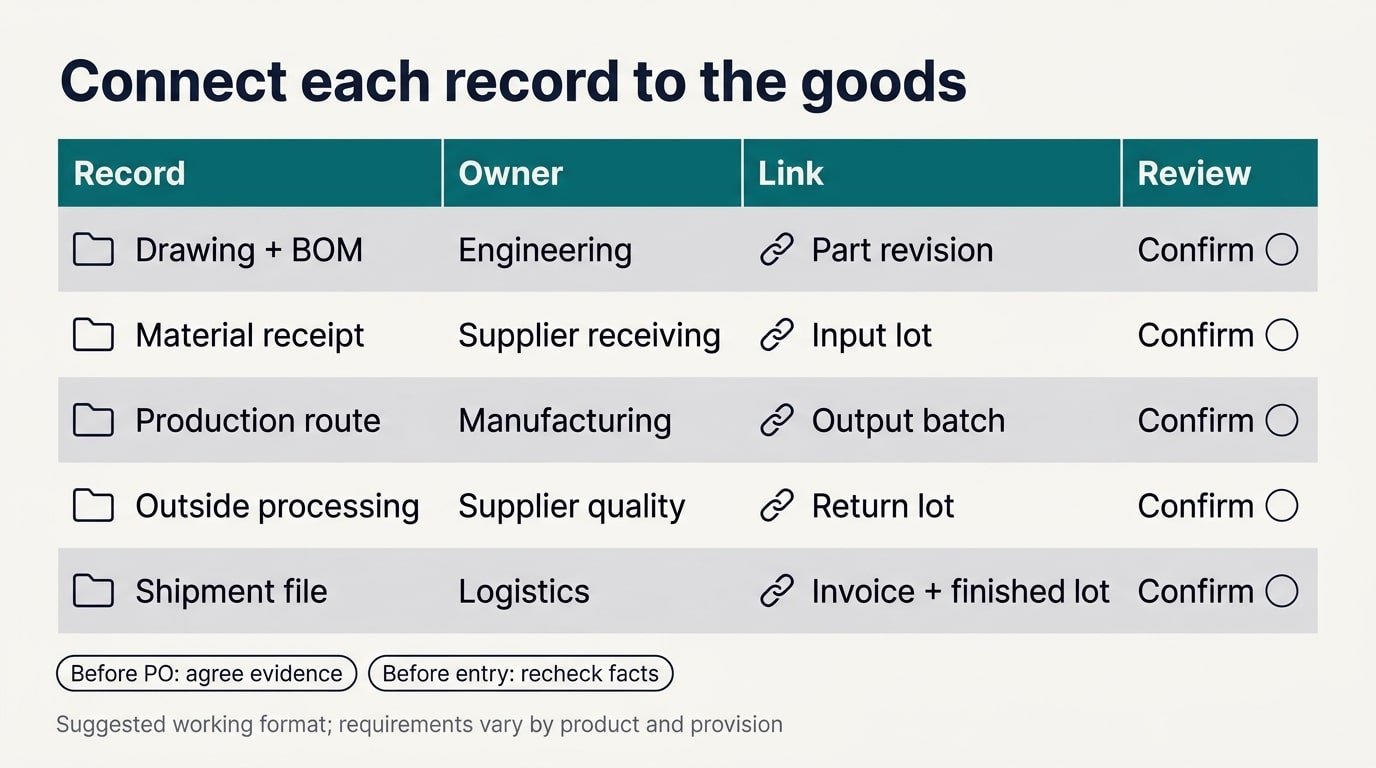
Start with a practical chain: purchase order, part revision, bill of materials, material receipt, production lot, outside processing, finished-goods lot and shipment. The identifiers do not have to be identical across every document, but the supplier should be able to explain the links and produce the cross-reference.
| Record | Suggested owner | Link to establish |
| Drawing and bill of materials | Engineering | Part number and approved revision |
| Material purchase and receipt | Supplier purchasing and receiving | Input supplier, material identity and receipt lot |
| Process route and production record | Manufacturing | Input lots, operations and output batch |
| Subcontracted work | Supplier quality | Sent quantity, processor, return lot and disposition |
| Metal-source information, when required | Supplier with upstream support | Applicable metal record and the covered goods |
| Packing list and shipment file | Logistics | Finished lot, quantity, invoice and shipment |
This is a recommended evidence structure. The exact documents required depend on the product and applicable provisions. Agree on access, confidentiality and document ownership before the first production order. A buyer should know who can retrieve records when the usual account manager is unavailable.
Keep finished good origin and metal source data separate
The place where a finished component is manufactured may differ from the place where its steel was melted and poured or its aluminum or copper was smelted and cast. Where the applicable metal rule requires that information, a finished-good origin statement does not answer the upstream question.
One concrete 2026 example concerns certain copper articles. CBP’s August 31 bulletin states that, beginning September 14, ACE would reject entry summaries missing required primary-smelt and cast reporting for HTSUS 8544.42.10, 8544.42.20, 8544.42.90 and 8544.49.10, subject to the notice’s scope. It also permits “OTH” for unknown countries under its instructions. This is a specific reporting example, not a requirement for every metal component.
Test the records with a real lot
During qualification, select one completed lot and ask the supplier to trace it backward to incoming materials and forward to shipment. Check how split lots, mixed material receipts, rework and subcontracted operations appear in the records. A polished sample certificate is less informative than a coherent explanation of a real transaction.
For an illustrative fabricated-frame order, the packing list might identify a finished-goods batch while the shop traveler identifies several input heats. Ask the supplier to show the connection, including how replacement material used during rework was recorded. If the link fails, describe the gap precisely: missing receipt identifier, unidentified outside processor or a quantity discrepancy. That gives the supplier an actionable correction and helps the importer assess what the available evidence can actually support.
The [Vietnam supplier qualification checklist] explains how to combine that exercise with process and quality evidence. Include a change-notification requirement so that a new material source, subcontractor or manufacturing location triggers review before the affected goods ship.
Use separate reviews before the purchase order and before entry
The first review establishes whether the proposed supply chain is sufficiently understood to commit commercially. The second confirms that the actual shipment still matches the reviewed facts and applicable rules.
Before the purchase order
Engineering confirms the product description and revision. The supplier identifies the production route and material sources. The importer and its advisers review classification, origin, valuation and potential trade-remedy exposure. Procurement records the resulting assumptions in the cost model and resolves who pays for additional documentation or outside analysis.
If an important question remains open, define what must happen before production or shipment proceeds. A request for a missing mill record needs a named owner. An unresolved origin issue may require more process evidence or a ruling discussion. Avoid allowing “the broker will handle it” to stand in for an agreed task and decision.
Before entry
Compare the commercial invoice, packing list, production information and shipping documents against the approved file. Recheck effective dates, exclusions and additional-duty provisions. Confirm whether the supplier changed a material source, processing location or product configuration after the quotation.
Keep the review outcome with the supporting records: who checked it, when, what changed and which questions remain. For repeat orders, focus on changes while retaining the ability to reproduce the earlier decision. The [first Vietnam sourcing pilot plan] places these reviews alongside sample approval, production release and ramp-up so that import readiness is part of the project schedule.
For a program running into 2027, assign one person to maintain the policy watch list and another to communicate supplier changes. Schedule the next review around the expected shipment and entry, rather than assuming the original purchase-order date preserves its tariff assumptions. If a delivery delay moves the entry into a different effective period, update both the import review and the cost forecast. Keep the commercial team informed before it makes commitments based on the earlier estimate.
Frequently asked questions
They may coincide, but shipping records alone do not establish origin. Document the manufacturing history and apply the relevant origin rules. A shipment leaving a Vietnamese port may contain goods with different production histories, so review the goods rather than assigning an answer to the container.
Ownership alone does not resolve the production-based analysis described above. Ask where the relevant manufacturing occurs, what inputs enter each operation and how the finished article is produced. Keep ownership information in the supplier file while evaluating origin through the applicable rules and manufacturing evidence.
No. The outcome depends on classification, origin, customs value, applicable additional measures, exceptions and entry date. The July 2026 notice itself includes exceptions. Procurement should receive a documented result for the part and shipment assumptions, rather than a country percentage copied into every spreadsheet row.
No single document answers classification, valuation, metal-source reporting and AD/CVD scope at once. Ask which statement the certificate supports and whether its underlying facts are available. Keep the certificate alongside the process and transaction records; do not treat its existence as completion of the entire import review.
Consider it when a material classification or origin uncertainty remains after gathering the product and process facts. Discuss the appropriate request before the planned transaction. The submission should describe the actual arrangement, and later changes should be evaluated against the ruling’s factual basis and conditions.
Prepare a more complete sourcing file
The next step after FABTECH can be a focused document review. Bring the drawing, material specification, expected volumes, proposed manufacturing route and intended U.S. delivery plan. Identify what the supplier can substantiate and what the importer still needs to confirm.
Discuss the documentation needed for your project with VNO, including supplier information and process records to be gathered within the agreed scope of support. Coordinate the import conclusions with your importer and customs advisers. A clear file gives the team a sounder basis for comparing costs, approving the supplier and planning the first shipment.
