
Introduction
Steel casting plays a critical role in modern industry, providing durable and versatile materials for construction, automotive, and heavy machinery. By pouring molten steel into molds and cooling it into solid form, manufacturers create both large blocks for forging and long bars for rolling. The development of continuous casting technology has further transformed efficiency and product quality. Which is also reflected in the development in aluminum casting in Vietnam
What Is Steel Casting?
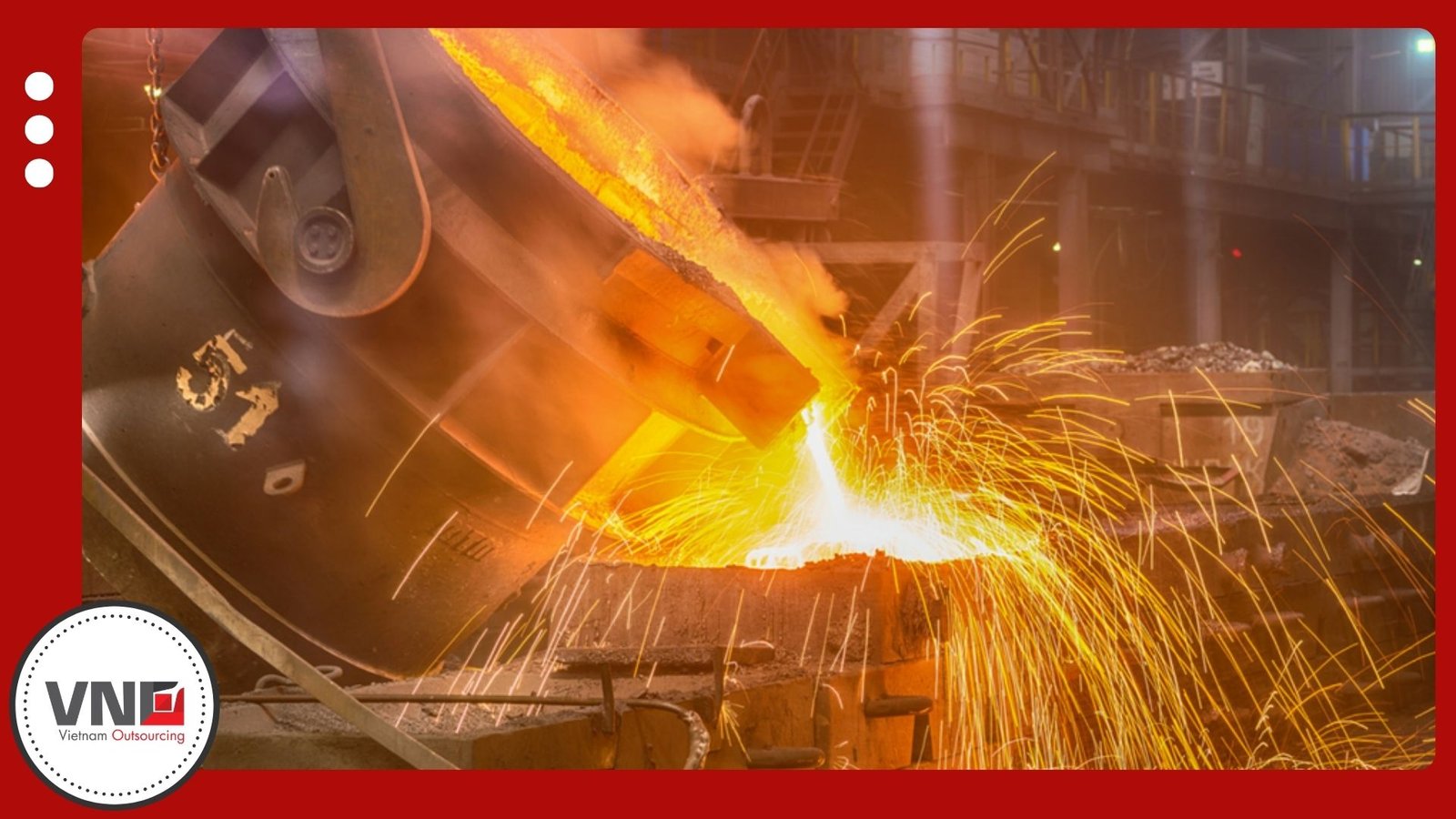
Steel casting involves pouring molten steel into a mold until it solidifies. Traditionally, large metal molds were used for blocks, while continuous casting now dominates for creating long steel bars. These cast products form the foundation for rolling, forging, or pressing into semi-finished and finished goods.
Continuous Casting Method
Continuous casting has become the preferred method due to its efficiency and structural advantages. In this process:
- Molten steel flows from a pre-furnace tank into an intermediate reservoir.
- Steel then enters a water-cooled bronze mold, where the outer layer solidifies.
- The partially solidified bar, with a liquid inner core, is continuously pulled downward.
- Rollers guide the bar into an arc-shaped cooling chamber where water sprays complete solidification.
- Once cooled, the bar straightens, undergoes adjustment, and is cut into pieces for further processing.
This method produces steel bars with fine microstructures, resulting in superior quality compared to traditional mold casting. It also minimizes the rolling steps needed later, saving time and cost.
Processing Steel After Casting
After steel casting, products are typically shaped into long bars or large blocks. These are then processed into:
- Semi-finished products: rolling blocks, billets, and slabs. These serve as intermediates for further shaping.
- Finished products: rebar, round bars, flat steel plates, laminates, steel pipes, and wire.
Through rolling, stretching, or pressing, steel achieves the exact dimensions and mechanical properties required for industrial use.
Advantages of Continuous Steel Casting
- Produces finer grain structures for stronger materials.
- Reduces machining and rolling steps.
- Provides consistent quality with fewer defects.
- Enhances productivity with continuous output.
Applications of Steel Casting
Steel casting supports industries that rely on strength and durability, including:
- Construction: rebar, beams, and plates.
- Automotive: engine components and frames.
- Energy: pipelines, turbines, and structural supports.
- Heavy machinery: gears, shafts, and wear-resistant parts.
Conclusion
Steel casting has evolved into an efficient, high-precision process that underpins global manufacturing. Continuous casting in particular has reshaped production, offering superior quality, lower costs, and high productivity. From semi-finished slabs to finished steel products, the process continues to fuel industries that depend on strength, reliability, and innovation and are highly developed by Vietnam die casting supplier.