Introduction
When comparing sand casting vs die casting, both are essential methods in modern manufacturing. They each provide unique advantages and challenges, making them suitable for different applications. Knowing how they differ in process, cost, and performance helps businesses choose the right solution. You might also want to know about gravity casting in Vietnam after finish reading this article.
What Is Sand Casting?
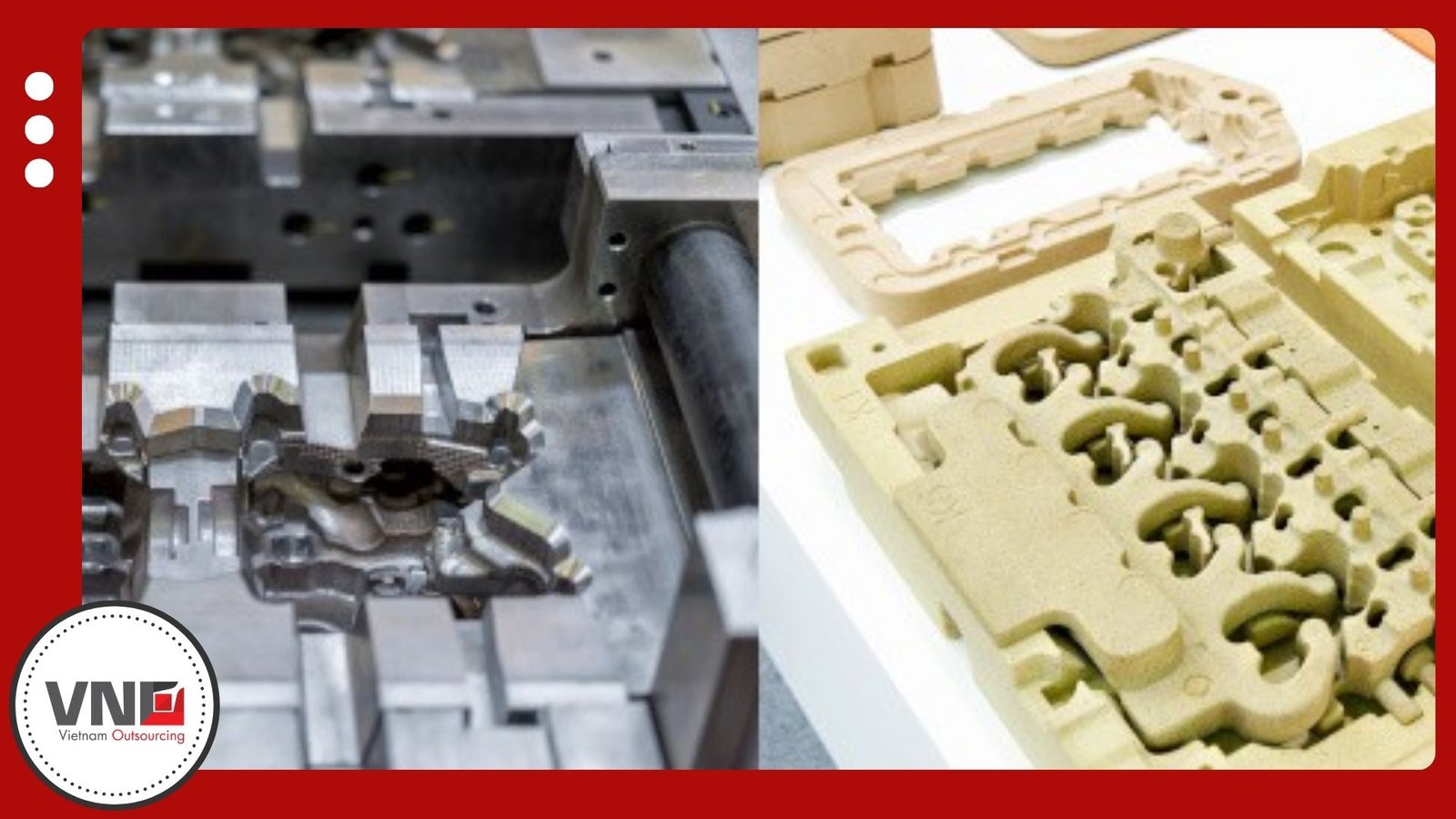
Sand casting uses molds made from treated sand. Foundries pour molten metal into the mold cavity, where it solidifies into the desired shape. This method is cost-effective and flexible, particularly for large components or complex internal geometries.
What Is Die Casting?
Die casting injects molten metal under high pressure into a reusable steel mold, known as a die. The result is a high-precision part with excellent surface finish and consistency. Manufacturers often select die casting for mass production, where speed and accuracy are critical.
Strengths of Sand Casting
-
Ability to produce very large components.
-
Flexibility for intricate designs and hollow sections.
-
Compatibility with a wide range of metals and alloys.
-
Low tooling costs compared to permanent molds.
-
Suitable for low-volume production or prototypes.
Strengths of Die Casting
-
Efficient for producing small and detailed parts.
-
Excellent surface quality, often reducing machining.
-
High dimensional accuracy with tight tolerances.
-
Strong, uniform, and durable parts.
-
Cost-effective for large-scale production.
Drawbacks of Sand Casting
-
Single-use sand molds increase waste.
-
Less accuracy than die casting.
-
Rough surface finish that often requires machining.
-
Longer production cycle compared to permanent mold methods.
Drawbacks of Die Casting
-
High initial investment in molds and machines.
-
Best suited only for high production volumes.
-
Limited to non-ferrous metals like aluminum, zinc, and magnesium.
-
Casting weight range is restricted, typically from 30g to 10kg.
-
Risk of porosity, which reduces weldability and heat treatment options.
Applications Across Industries
Sand casting works well for heavy equipment, engine blocks, industrial housings, and marine propellers. Meanwhile, die casting is the go-to choice for automotive systems, electronics housings, lighting fixtures, and precision tools. Each method supports industries that rely on durable, high-performance parts.
Conclusion
The choice between sand casting vs die casting depends on project requirements. Sand casting is recommended by Vietnam die casting supplier because it is more practical for large and complex parts with lower production volumes. Die casting, on the other hand, is ideal for high-precision, mass-produced components. Together, these methods remain at the core of global manufacturing.